The Knapsack, the Hat, and the Horn

Introduction

This is a classic 'magic objects' tale, catalogued by folklorists as ATU 569. Its opening hides an intriguing choice: three brothers come upon a hill of silver and then a hill of gold, and the first two take their fill and go contentedly home, while only the youngest says 'silver and gold do not move me' and presses on — and the three treasures he finally wins (a never-empty wishing-cloth, a knapsack that summons an army, a hat that fires cannons, a horn that levels walls) far outshine mere gold. That self-spreading food-cloth belongs to the same family as the treasure in another tale on this site, 'The Wishing-Table, the Gold-Ass, and the Cudgel' (in German both are called Tischlein deck dich, 'little table, set yourself'); while the wishing-hat and endless riches trace back to the medieval romance 'Fortunatus.' The second half brings a familiar figure, too: the princess who coaxes out her husband's magic secret and then steals his treasures while he sleeps — exactly like the wife who steals the wishing-ring in this site's 'The King of the Golden Mountain,' and a distant echo of Delilah wheedling the source of Samson's strength from him in the Bible. Be warned, though, that this hero is no traditional role model: he wins by cleverness but also by repeated trickery and force, and the ending is bloody. The old tale sets the thrill and the cost side by side before the child — which leaves us a fine space to talk it over.

Font Size
Image Layout
1 / 31
Stopped
There were once three brothers who had fallen deeper and deeper into poverty, and at last their need was so great that they had to endure hunger, and had nothing to eat or drink. Then said they, "We cannot go on thus, we had better go into the world and seek our fortune." They therefore set out, and had already walked over many a long road and many a blade of grass, but had not yet met with good luck.
One day they arrived in a great forest, and in the midst of it was a hill, and when they came nearer they saw that the hill was all silver. Then spoke the eldest, "Now I have found the good luck I wished for, and I desire nothing more." He took as much of the silver as he could possibly carry, and then turned back and went home again.
But the two others said, "We want something more from good luck than mere silver," and did not touch it, but went onwards. After they had walked for two days longer without stopping, they came to a hill which was all gold. The second brother stopped, took thought with himself, and was undecided. "What shall I do?" said he; "shall I take for myself so much of this gold, that I have sufficient for all the rest of my life, or shall I go farther?" At length he made a decision, and putting as much into his pockets as would go in, said farewell to his brother, and went home.
But the third said, "Silver and gold do not move me, I will not renounce my chance of fortune, perhaps something better still will be given me." He journeyed onwards, and when he had walked for three days, he got into a forest which was still larger than the one before, and never would come to an end, and as he found nothing to eat or to drink, he was all but exhausted.
Then he climbed up a high tree to find out if up there he could see the end of the forest, but so far as his eye could pierce he saw nothing but the tops of trees. Then he began to descend the tree again, but hunger tormented him, and he thought to himself, "If I could but eat my fill once more!"
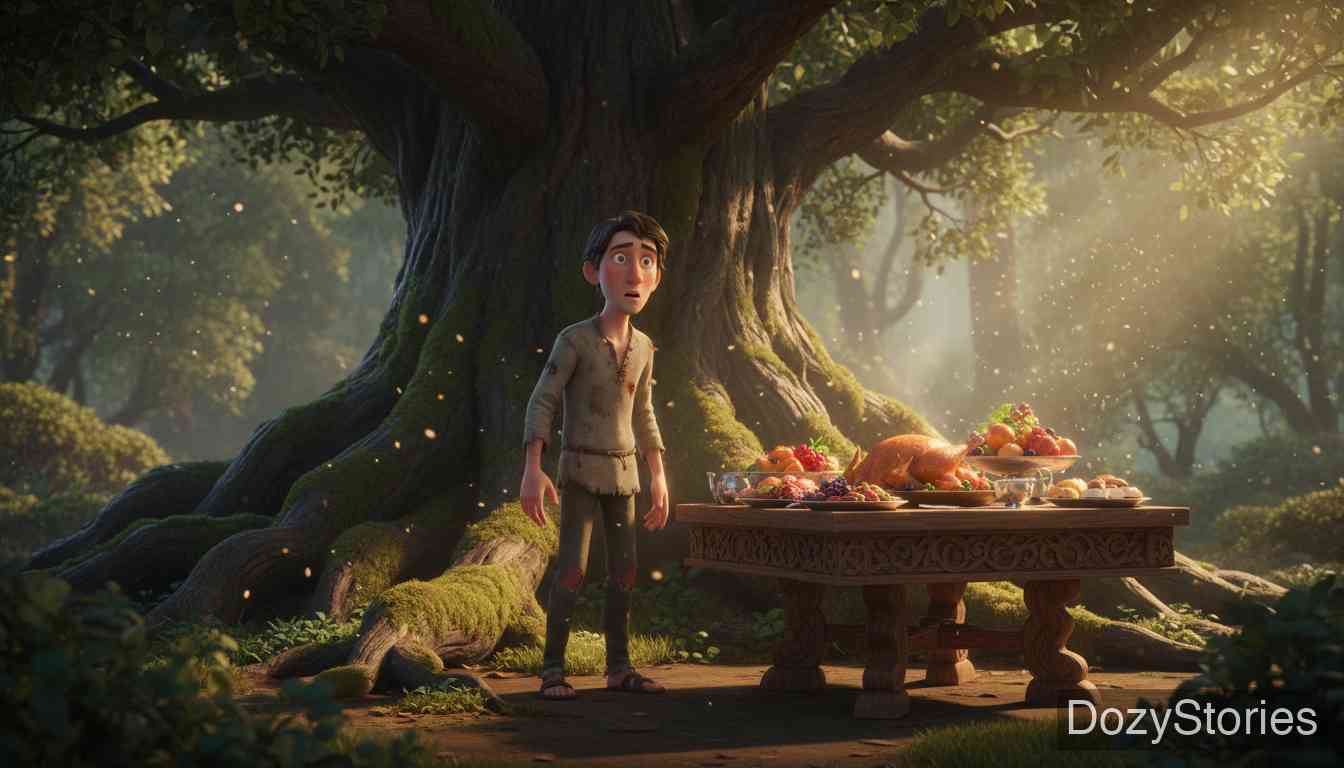
When he got down he saw with astonishment a table beneath the tree richly spread with food, the steam of which rose up to meet him. "This time," said he, "my wish has been fulfilled at the right moment." And without inquiring who had brought the food, or who had cooked it, he approached the table, and ate with enjoyment until he had appeased his hunger.
When he was done, he thought, "It would after all be a pity if the pretty little table-cloth were to be spoilt in the forest here," and folded it up tidily and put it in his pocket. Then he went onwards, and in the evening, when hunger once more made itself felt, he wanted to make a trial of his little cloth, and spread it out and said, "I wish thee to be covered with good cheer again," and scarcely had the wish crossed his lips than as many dishes with the most exquisite food on them stood on the table as there was room for.
"Now I perceive," said he, "in what kitchen my cooking is done. Thou shalt be dearer to me than the mountains of silver and gold." For he saw plainly that it was a wishing-cloth. The cloth, however, was still not enough to enable him to sit down quietly at home; he preferred to wander about the world and pursue his fortune farther.
One night he met, in a lonely wood, a dusty, black charcoal-burner, who was burning charcoal there, and had some potatoes by the fire, on which he was going to make a meal. "Good evening, blackbird!" said the youth. "How dost thou get on in thy solitude?"
"One day is like another," replied the charcoal-burner, "and every night potatoes! Hast thou a mind to have some, and wilt thou be my guest?" - "Many thanks," replied the traveler, "I won't rob thee of thy supper; thou didst not reckon on a visitor, but if thou wilt put up with what I have, thou shalt have an invitation."
"Who is to prepare it for thee?" said the charcoal-burner. "I see that thou hast nothing with thee, and there is no one within a two hours' walk who could give thee anything." - "And yet there shall be a meal," answered the youth, "and better than any thou hast ever tasted."
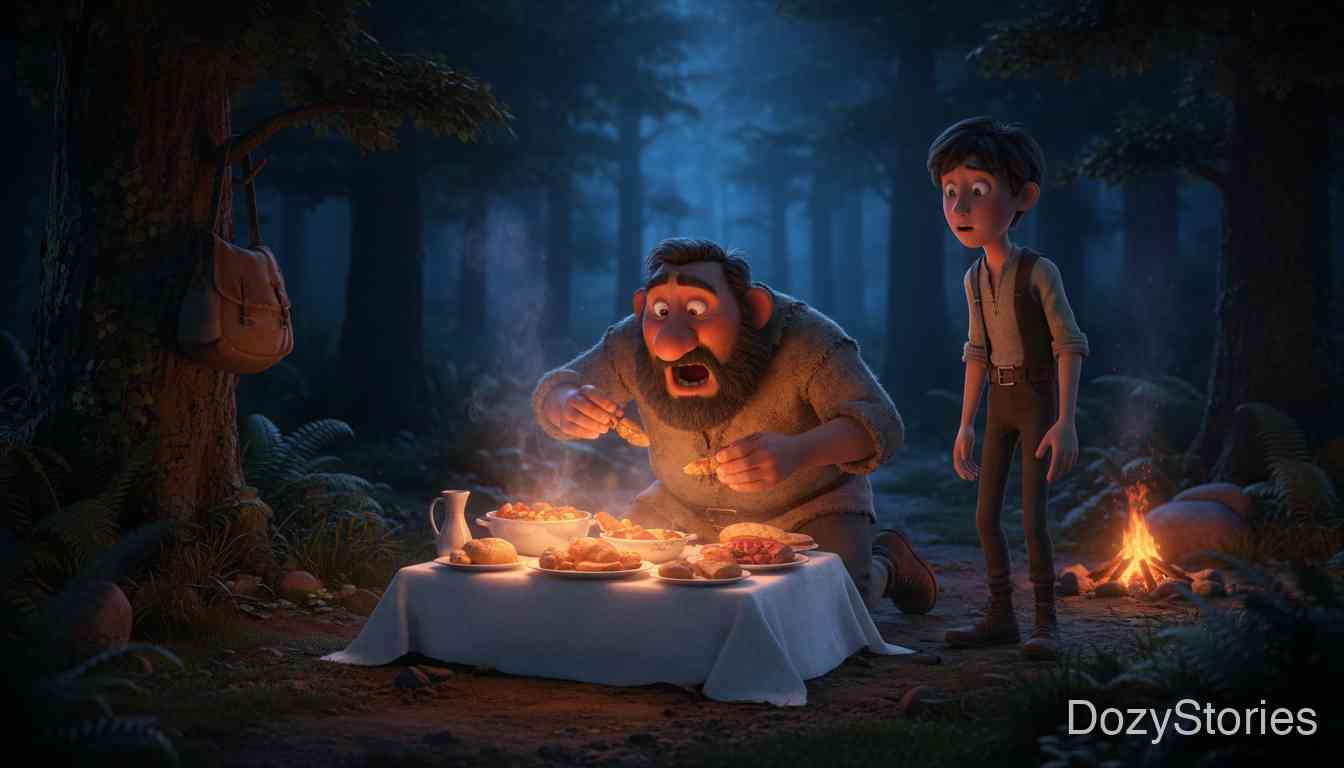
Thereupon he brought his cloth out of his knapsack, spread it on the ground, and said, "Little cloth, cover thyself," and instantly boiled meat and baked meat stood there, and as hot as if it had just come out of the kitchen. The charcoal-burner stared, but did not require much pressing; he fell to, and thrust larger and larger mouthfuls into his black mouth.
When they had eaten everything, the charcoal-burner smiled contentedly, and said, "Hark thee, thy table-cloth has my approval; it would be a fine thing for me in this forest, where no one ever cooks me anything good. I will propose an exchange to thee; there in the corner hangs a soldier's knapsack, which is certainly old and shabby, but in it lie concealed wonderful powers; but, as I no longer use it, I will give it to thee for the table-cloth."
"I must first know what these wonderful powers are," answered the youth. "That will I tell thee," replied the charcoal-burner; "every time thou tappest it with thy hand, a corporal comes with six men armed from head to foot, and they do whatsoever thou commandest them."
"So far as I am concerned," said the youth, "if nothing else can be done, we will exchange," and he gave the charcoal-burner the cloth, took the knapsack from the hook, put it on, and bade farewell. When he had walked a while, he wished to make a trial of the magical powers of his knapsack and tapped it.
Immediately the seven warriors stepped up to him, and the corporal said, "What does my lord and ruler wish for?" - "March with all speed to the charcoal-burner, and demand my wishing-cloth back." They faced to the left, and it was not long before they brought what he required, and had taken it from the charcoal-burner without asking many questions. The young man bade them retire, went onwards, and hoped fortune would shine yet more brightly on him.
By sunset he came to another charcoal-burner, who was making his supper ready by the fire. "If thou wilt eat some potatoes with salt, but with no dripping, come and sit down with me," said the sooty fellow. "No, he replied, this time thou shalt be my guest," and he spread out his cloth, which was instantly covered with the most beautiful dishes.
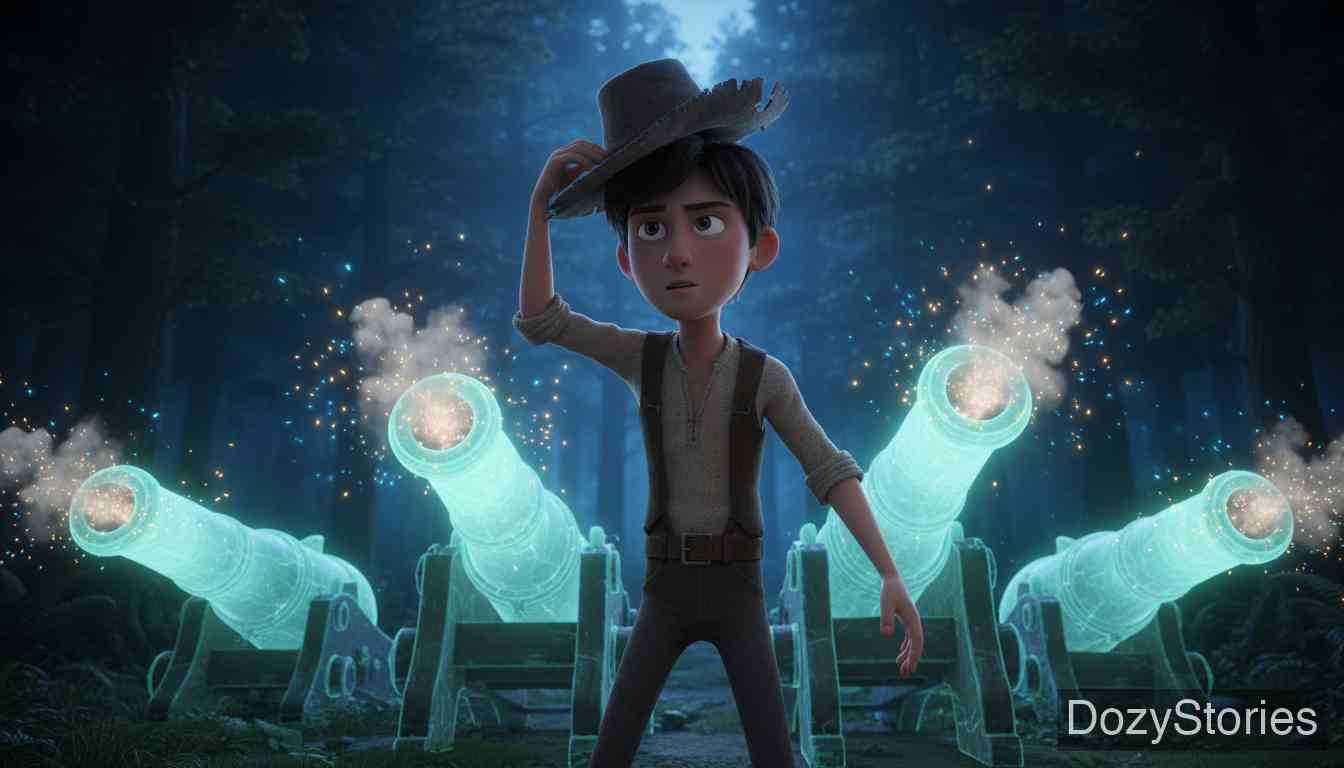
They ate and drank together, and enjoyed themselves heartily. After the meal was over, the charcoal-burner said, "Up there on that shelf lies a little old worn-out hat which has strange properties: when any one puts it on, and turns it round on his head, the cannons go off as if twelve were fired all together, and they shoot down everything so that no one can withstand them. The hat is of no use to me, and I will willingly give it for thy table-cloth."
"That suits me very well," he answered, took the hat, put it on, and left his table-cloth behind him. Hardly, however, had he walked away than he tapped on his knapsack, and his soldiers had to fetch the cloth back again. "One thing comes on the top of another," thought he, "and I feel as if my luck had not yet come to an end."
Neither had his thoughts deceived him. After he had walked on for the whole of one day, he came to a third charcoal-burner, who like the previous ones, invited him to potatoes without dripping. But he let him also dine with him from his wishing-cloth, and the charcoal-burner liked it so well, that at last he offered him a horn for it, which had very different properties from those of the hat.
When any one blew it all the walls and fortifications fell down, and all towns and villages became ruins. He certainly gave the charcoal-burner the cloth for it, but he afterwards sent his soldiers to demand it back again, so that at length he had the knapsack, hat and horn, all three. "Now," said he, "I am a made man, and it is time for me to go home and see how my brothers are getting on."
When he reached home, his brothers had built themselves a handsome house with their silver and gold, and were living in clover. He went to see them, but as he came in a ragged coat, with his shabby hat on his head, and his old knapsack on his back, they would not acknowledge him as their brother. They mocked and said, "Thou givest out that thou art our brother who despised silver and gold, and craved for something still better for himself. He will come in his carriage in full splendour like a mighty king, not like a beggar," and they drove him out of doors.
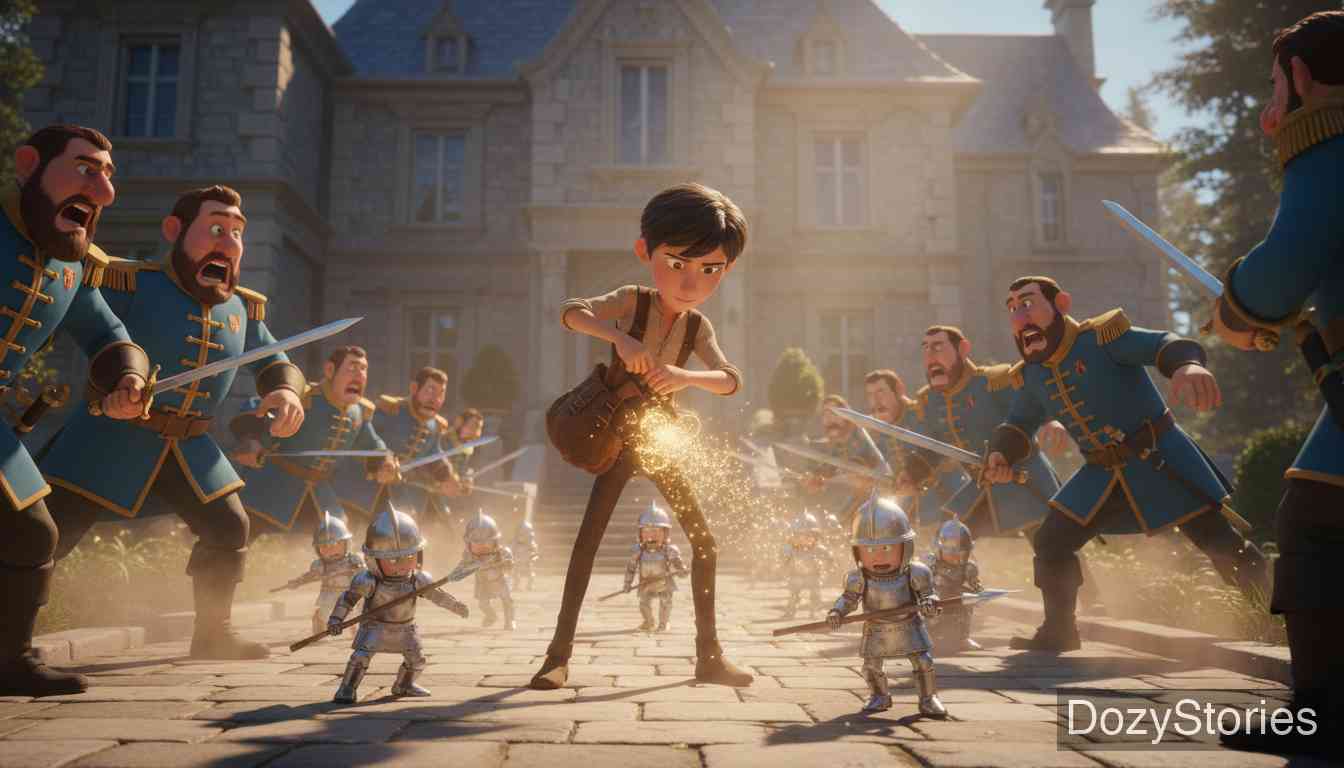
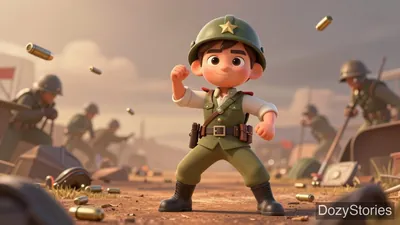
Then he fell into a rage, and tapped his knapsack until a hundred and fifty men stood before him armed from head to foot. He commanded them to surround his brothers' house, and two of them were to take hazel-sticks with them, and beat the two insolent men until they knew who he was. A violent disturbance arose, people ran together, and wanted to lend the two some help in their need, but against the soldiers they could do nothing.
News of this at length came to the King, who was very angry, and ordered a captain to march out with his troop, and drive this disturber of the peace out of the town; but the man with the knapsack soon got a greater body of men together, who repulsed the captain and his men, so that they were forced to retire with bloody noses.
The King said, "This vagabond is not brought to order yet," and next day sent a still larger troop against him, but they could do even less. The youth set still more men against them, and in order to be done the sooner, he turned his hat twice round on his head, and heavy guns began to play, and the king's men were beaten and put to flight.
"And now," said he, "I will not make peace until the King gives me his daughter to wife, and I govern the whole kingdom in his name." He caused this to be announced to the King, and the latter said to his daughter, "Necessity is a hard nut to crack, what remains to me but to do what he desires? If I want peace and to keep the crown on my head, I must give thee away."
So the wedding was celebrated, but the King's daughter was vexed that her husband should be a common man, who wore a shabby hat, and put on an old knapsack. She wished much to get rid of him, and night and day studied how she could accomplished this. Then she thought to herself, "Is it possible that his wonderful powers lie in the knapsack?" and she dissembled and caressed him, and when his heart was softened, she said, "If thou wouldst but lay aside that ugly knapsack, it makes disfigures thee so, that I can't help being ashamed of thee."
"Dear child," said he, "this knapsack is my greatest treasure; as long as I have it, there is no power on earth that I am afraid of." And he revealed to her the wonderful virtue with which it was endowed. Then she threw herself in his arms as if she were going to kiss him, but dexterously took the knapsack off his shoulders, and ran away with it. As soon as she was alone she tapped it, and commanded the warriors to seize their former master, and take him out of the royal palace.
They obeyed, and the false wife sent still more men after him, who were to drive him quite out of the country. Then he would have been ruined if he had not had the little hat. But his hands were scarcely at liberty before he turned it twice. Immediately the cannon began to thunder, and struck down everything, and the King's daughter herself was forced to come and beg for mercy.
As she entreated in such moving terms, and promised amendment, he allowed himself to be persuaded and granted her peace. She behaved in a friendly manner to him, and acted as if she loved him very much, and after some time managed so to befool him, that he confided to her that even if someone got the knapsack into his power, he could do nothing against him so long as the old hat was still his. When she knew the secret, she waited until he was asleep, and then she took the hat away from him, and had it thrown out into the street.
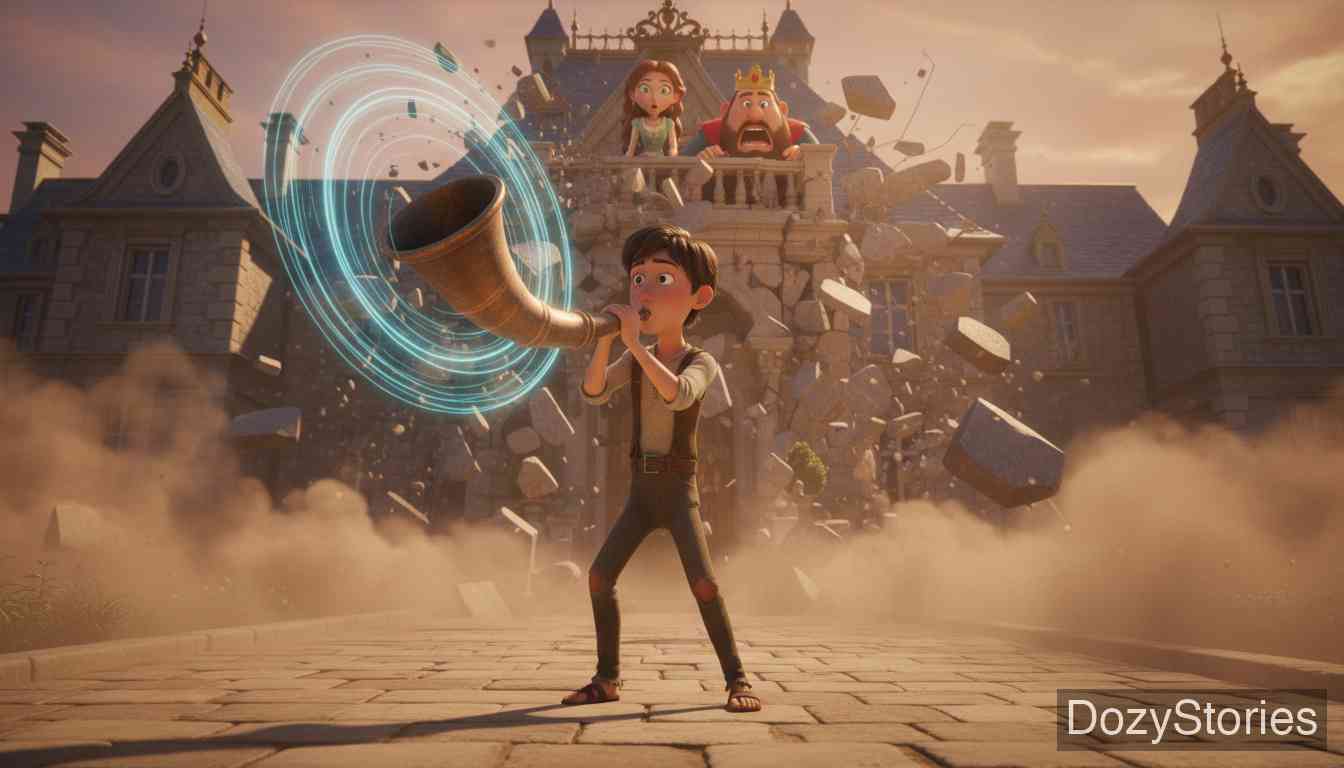
But the horn still remained to him, and in great anger he blew it with all his strength. Instantly all walls, fortifications, towns, and villages, toppled down, and crushed the King and his daughter to death. And had he not put down the horn and had blown just a little longer, everything would have been in ruins, and not one stone would have been left standing on another. Then no one opposed him any longer, and he made himself King of the whole country.

Vocabulary from "The Knapsack, the Hat, and the Horn"

12 key words from this story with definitions and original context sentences for language learners.

povertyB2
/ˈpɒvərti/n.

The state of being very poor.

贫穷;贫困。

There were once three brothers who had fallen deeper and deeper into poverty.

从前有三兄弟,他们越来越穷,陷入了贫困。

exhaustedB1
/ɪɡˈzɔːstɪd/adj.

Extremely tired; having no energy left.

筋疲力尽的;耗尽的。

As he found nothing to eat or to drink, he was all but exhausted.

由于找不到吃喝,他几乎筋疲力尽。

renounceC1
/rɪˈnaʊns/v.

To give up a claim, right, or possession, especially formally.

放弃;抛弃(权利、机会等)。

Silver and gold do not move me, I will not renounce my chance of fortune.

银子和金子打动不了我,我不会放弃我的机会。

appeased(appease)C1
/əˈpiːzd/v.

Satisfied or calmed a need or feeling (such as hunger).

满足;平息(饥饿、怒气等)。

He approached the table, and ate with enjoyment until he had appeased his hunger.

他走到桌前尽情享用,直到吃饱(平息了饥饿)为止。

perceiveB2
/pərˈsiːv/v.

To become aware of or understand something.

察觉;意识到;看出。

Now I perceive, said he, in what kitchen my cooking is done.

现在我明白(看出)了,他说,我的饭是在哪个厨房做的。

concealed(conceal)B2
/kənˈsiːld/v.

Hidden; kept out of sight.

隐藏的;暗藏的。

There hangs a soldier's knapsack, in it lie concealed wonderful powers.

那边挂着一个士兵的背囊,里面藏着神奇的力量。

shabbyB2
/ˈʃæbi/adj.

Worn-out and in poor condition.

破旧的;褴褛的。

He came in a ragged coat, with his shabby hat on his head, and his old knapsack on his back.

他穿着破烂的外套,戴着破旧的帽子,背着旧背囊。

insolentC1
/ˈɪnsələnt/adj.

Rude and disrespectful.

傲慢无礼的;蛮横的。

Two of them were to take hazel-sticks, and beat the two insolent men until they knew who he was.

其中两人要带着榛木棍,狠狠地揍那两个傲慢的人,直到他们认出他是谁。

despised(despise)B2
/dɪˈspaɪzd/v.

Looked down on; regarded with contempt.

鄙视;看不起。

Thou art our brother who despised silver and gold, and craved for something still better.

你说你是我们那个视金银如粪土、渴望更好东西的兄弟。

dissembled(dissemble)C1
/dɪˈsembld/v.

Hid one's true feelings or intentions; pretended.

掩饰(真实感情或意图);假装。

She dissembled and caressed him, and when his heart was softened, she said...

她假意亲热,抚爱着他,当他心软时,她说……

dexterouslyC1
/ˈdekstrəsli/adv.

In a skilful, nimble way with the hands.

灵巧地;敏捷娴熟地。

She dexterously took the knapsack off his shoulders, and ran away with it.

她敏捷地从他肩上取下背囊,拿着它跑了。

mocked(mock)B2
/mɒkt/v.

Laughed at someone in a cruel, scornful way.

嘲笑;奚落。

They mocked and said, "Thou givest out that thou art our brother..."

他们嘲笑说:'你说你是我们的兄弟……'

Reading Together & Learning More

The Moral

The two elder brothers settle for a heap of silver and a heap of gold, but the youngest trusts that 'perhaps something better still lies ahead' — not letting an immediate gain trip you up often carries you farther. Yet the tale also warns us: great power used only for revenge and conquest does not guarantee a happy ending. The real challenge is never how to win, but knowing when to stop.

Educational Value

Good for discussing delayed gratification and larger ambition, and for exploring the two faces of power: the hero's rise by wit and magic is satisfying, but his repeated trickery, use of force, and grim final act make excellent material for reflection — once we are powerful, how should we behave?

Tips for Parents

A gentle heads-up: at the end the hero blows the horn and crushes the King and princess to death — quite violent. Rather than treating this as a 'victory' to admire, use it to discuss with your child: does solving every problem by force actually make him happier? The princess's theft is hateful, but is levelling everything an overreaction? You might also ask why the youngest brother walked past whole hills of silver and gold.

Talk About It

  1. The two elder brothers take their silver and gold and go home content, but the youngest says 'perhaps something better lies ahead.' Do you think that is clever, or too greedy? At which hill would you have stopped?
  2. The youngest keeps trading his cloth for treasures, then sends soldiers to steal the cloth back. Do you think that 'having it both ways' cleverness is fair?
  3. The princess coaxes out her husband's secret and steals his treasures — almost exactly like the wife in 'The King of the Golden Mountain.' Why do so many stories have the mightiest treasures undone by someone close?
  4. In the end the hero blows the horn and crushes the King and princess. He wins — but do you think he is happy? Could the story have ended some other way?
  5. If these three treasures came into your hands, what would you use them for?