The King's Son Who Feared Nothing

Introduction

This is an adventure that weaves several ancient heroic motifs together (folklorists place it roughly around ATU 590/401). The opening 'tree of life,' hung with golden apples and guarded by wild beasts, instantly recalls the forbidden tree in the Bible's Garden of Eden, and the dragon-guarded golden apples of the Hesperides in Greek myth. The story's central trial — enduring three nights in an enchanted castle, bearing every torment in silence to free a maiden who slowly turns 'from black to white' — is exactly the task the prince faces to free the serpent-princess in this site's 'The King of the Golden Mountain': both are the ancient motif of 'breaking a spell through silent endurance.' As for the theme of fearlessness, it chimes with this site's 'The Youth Who Went Forth to Learn What Fear Was': one hero cannot learn to be afraid, the other feels fear yet never makes a sound — a fine chance to ask your child which kind of 'fearlessness' truly counts as courage. And do not forget the faithful lion: it draws its blinded master back from the cliff-edge time after time, one of the most moving of the 'grateful animal helper' motifs (you have met its kin in 'The White Snake').

Font Size
Image Layout
1 / 76
Stopped
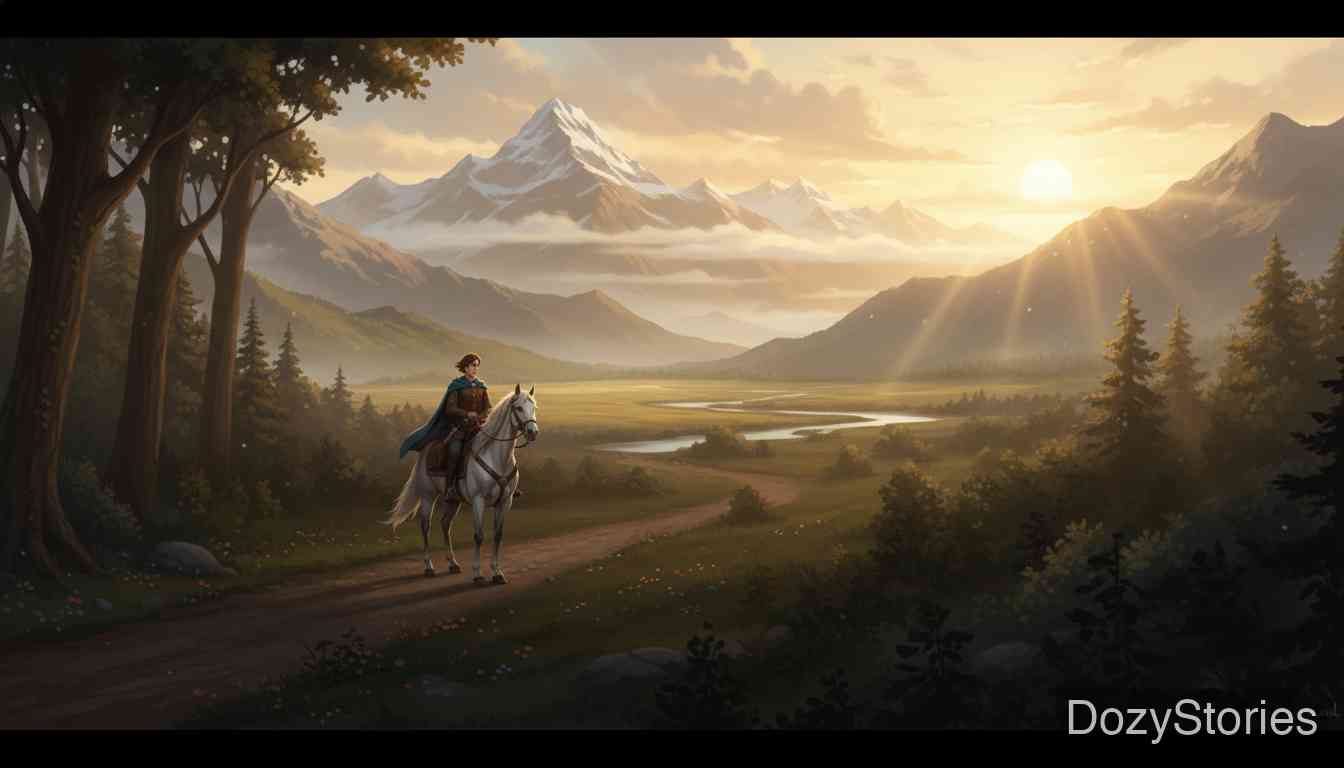
There was once a King's son, who was no longer content to stay at home in his father's house, and as he had no fear of anything, he thought, "I will go forth into the wide world, there the time will not seem long to me, and I shall see wonders enough."
So he took leave of his parents, and went forth, and on and on from morning till night, and whichever way his path led it was the same to him.
It came to pass that he got to the house of a giant, and as he was so tired he sat down by the door and rested. And as he let his eyes roam here and there, he saw the giant's playthings lying in the yard. These were a couple of enormous balls, and nine-pins as tall as a man.
After a while he had a fancy to set the nine-pins up and then rolled the balls at them, and screamed and cried out when the nine-pins fell, and had a merry time of it.
The giant heard the noise, stretched his head out of the window, and saw a man who was not taller than other men, and yet played with his nine-pins.
"Little worm," cried he, "why art thou playing with my balls? Who gave thee strength to do it?"
The King's son looked up, saw the giant, and said, "Oh, thou blockhead, thou thinkest indeed that thou only hast strong arms, I can do everything I want to do."
The giant came down and watched the bowling with great admiration, and said, "Child of man, if thou art one of that kind, go and bring me an apple of the tree of life."
"What dost thou want with it?" said the King's son.
"I do not want the apple for myself," answered the giant, "but I have a betrothed bride who wishes for it. I have travelled far about the world and cannot find the tree."
"I will soon find it," said the King's son, "and I do not know what is to prevent me from getting the apple down."
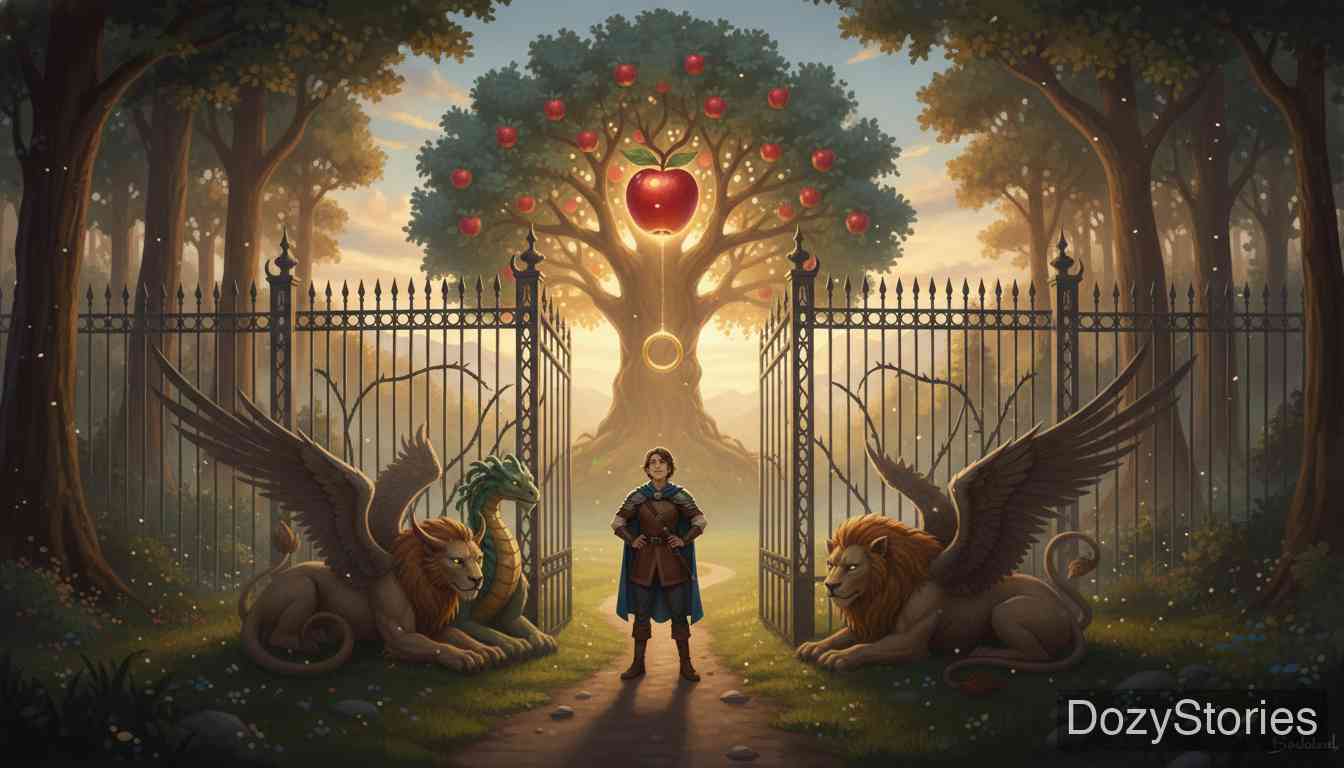
The giant said, "Thou really believest it to be so easy! The garden in which the tree stands is surrounded by an iron railing, and in front of the railing lie wild beasts, each close to the other, and they keep watch and let no man go in."
"They will be sure to let me in," said the King's son.
"Yes, but even if thou dost get into the garden, and seest the apple hanging to the tree, it is still not thine; a ring hangs in front of it, through which any one who wants to reach the apple and break it off, must put his hand, and no one has yet had the luck to do it."
"That luck will be mine," said the King's son.
Then he took leave of the giant, and went forth over mountain and valley, and through plains and forests, until at length he came to the wondrous garden.
The beasts lay round about it, but they had put their heads down and were asleep. Moreover, they did not awake when he went up to them, so he stepped over them, climbed the fence, and got safely into the garden.
There, in the very middle of it, stood the tree of life, and the red apples were shining upon the branches.
He climbed up the trunk to the top, and as he was about to reach out for an apple, he saw a ring hanging before it; but he thrust his hand through that without any difficulty, and gathered the apple.
The ring closed tightly on his arm, and all at once he felt a prodigious strength flowing through his veins.
When he had come down again from the tree with the apple, he would not climb over the fence, but grasped the great gate, and had no need to shake it more than once before it sprang open with a loud crash.
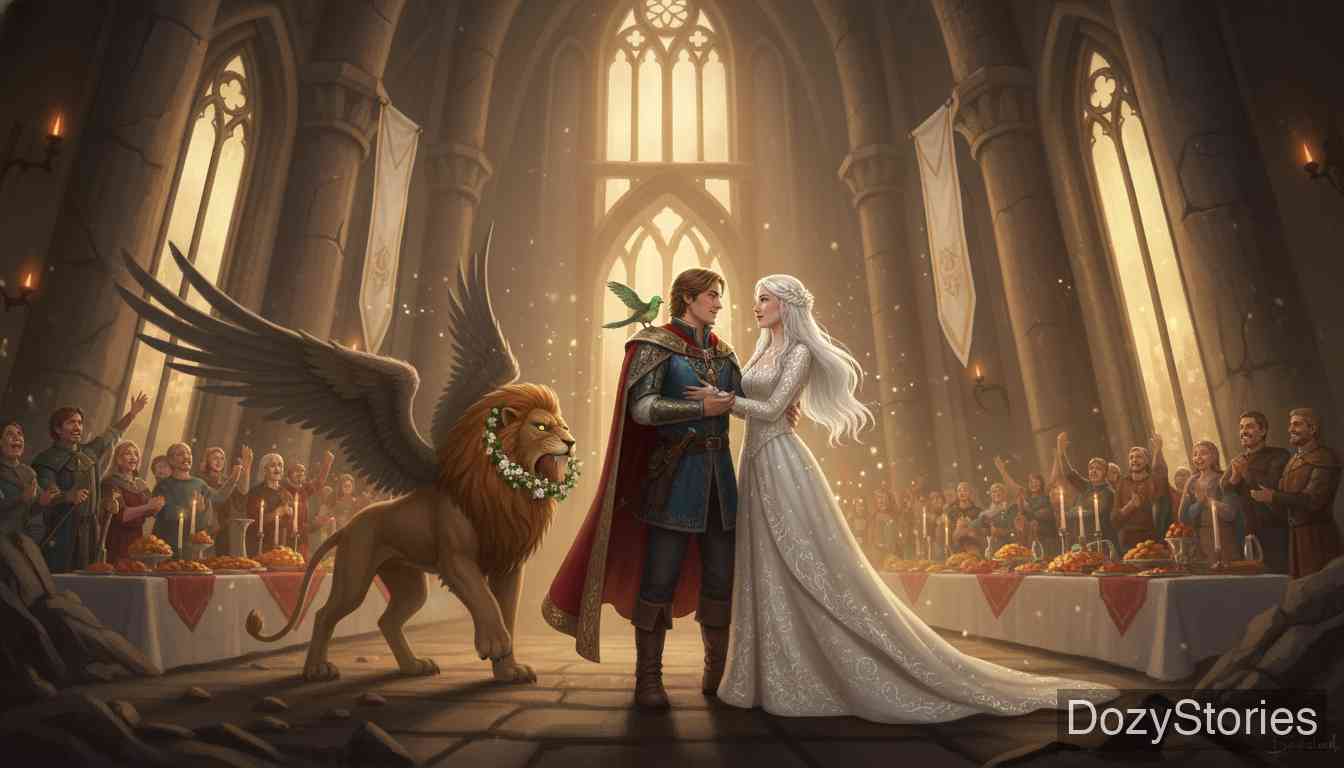
Then he went out, and the lion which had been lying down before, was awake and sprang after him, not in rage and fierceness, but following him humbly as its master.
The King's son took the giant the apple he had promised him, and said, "Seest thou, I have brought it without difficulty."
The giant was glad that his desire had been so soon satisfied, hastened to his bride, and gave her the apple for which she had wished.
She was a beautiful and wise maiden, and as she did not see the ring on his arm, she said, "I shall never believe that thou hast brought the apple, until I see the ring on thine arm."
The giant said, "I have nothing to do but go home and fetch it," and thought it would be easy to take away by force from the weak man, what he would not give of his own free will.
He therefore demanded the ring from him, but the King's son refused it.
"Where the apple is, the ring must be also," said the giant; "if thou wilt not give it of thine own accord, thou must fight with me for it."
They wrestled with each other for a long time, but the giant could not get the better of the King's son, who was strengthened by the magical power of the ring.
Then the giant thought of a stratagem, and said, "I have got warm with fighting, and so hast thou. We will bathe in the river, and cool ourselves before we begin again."
The King's son, who knew nothing of falsehood, went with him to the water, and pulled off with his clothes the ring also from his arm, and sprang into the river.
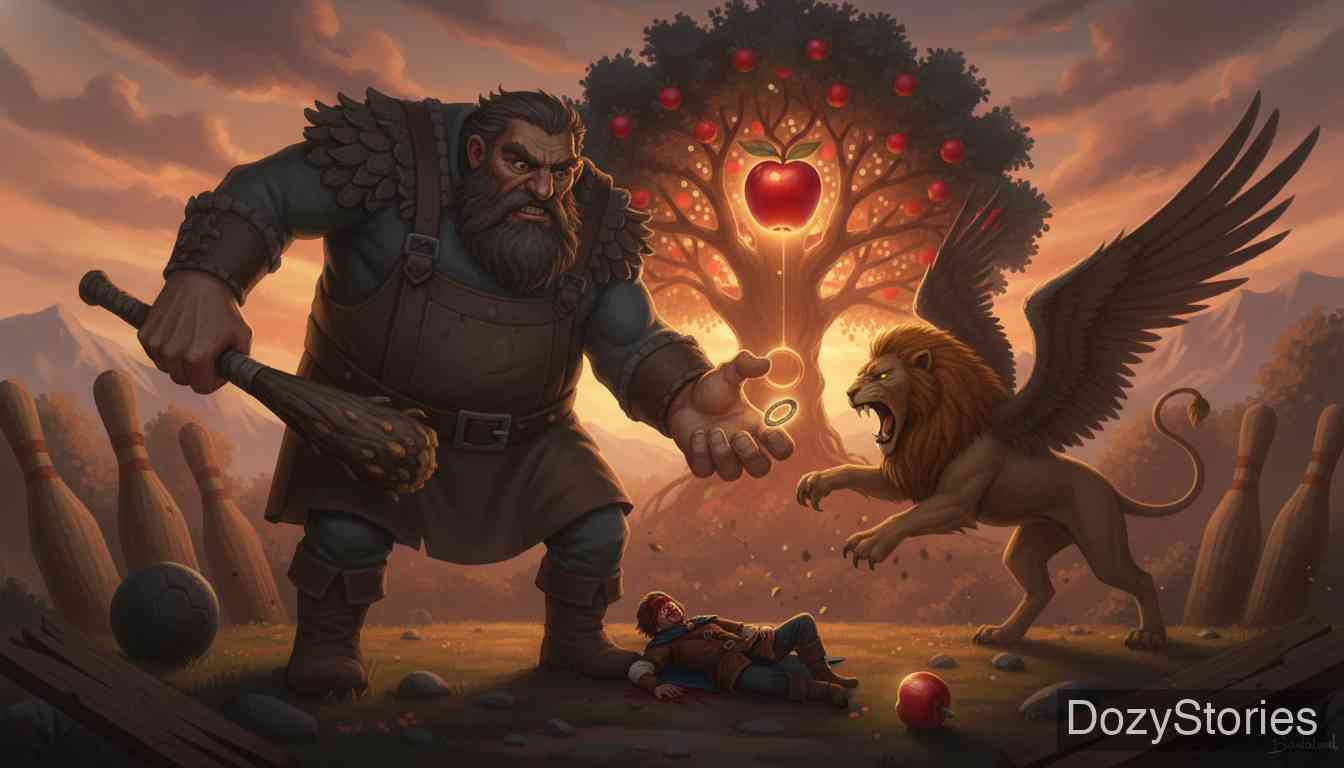
The giant instantly snatched the ring, and ran away with it, but the lion, which had observed the theft, pursued the giant, tore the ring out of his hand, and brought it back to its master.
Then the giant placed himself behind an oak-tree, and while the King's son was busy putting on his clothes again, surprised him, and put both his eyes out.
And now the unhappy King's son stood there, and was blind and knew not how to help himself.
Then the giant came back to him, took him by the hand as if he were someone who wanted to guide him, and led him to the top of a high rock.
There he left him standing, and thought, "Just two steps more, and he will fall down and kill himself, and I can take the ring from him."
But the faithful lion had not deserted its master; it held him fast by the clothes, and drew him gradually back again.
When the giant came and wanted to rob the dead man, he saw that his cunning had been in vain.
"Is there no way, then, of destroying a weak child of man like that?" said he angrily to himself, and seized the King's son and led him back again to the precipice by another way, but the lion which saw his evil design, helped its master out of danger here also.
When they had got close to the edge, the giant let the blind man's hand drop, and was going to leave him behind alone, but the lion pushed the giant so that he was thrown down and fell, dashed to pieces, on the ground.
The faithful animal again drew its master back from the precipice, and guided him to a tree by which flowed a clear brook.
The King's son sat down there, but the lion lay down, and sprinkled the water in his face with its paws.
Scarcely had a couple of drops wetted the sockets of his eyes, than he was once more able to see something, and remarked a little bird flying quite close by, which wounded itself against the trunk of a tree.
On this it went down to the water and bathed itself therein, and then it soared upwards and swept between the trees without touching them, as if it had recovered its sight again.
Then the King's son recognized a sign from God and stooped down to the water, and washed and bathed his face in it.
And when he arose he had his eyes once more, brighter and clearer than they had ever been.
The King's son thanked God for his great mercy, and travelled with his lion onwards through the world.
And it came to pass that he arrived before a castle which was enchanted. In the gateway stood a maiden of beautiful form and fine face, but she was quite black.
She spoke to him and said, "Ah, if thou couldst but deliver me from the evil spell which is thrown over me."
"What shall I do?" said the King's son.
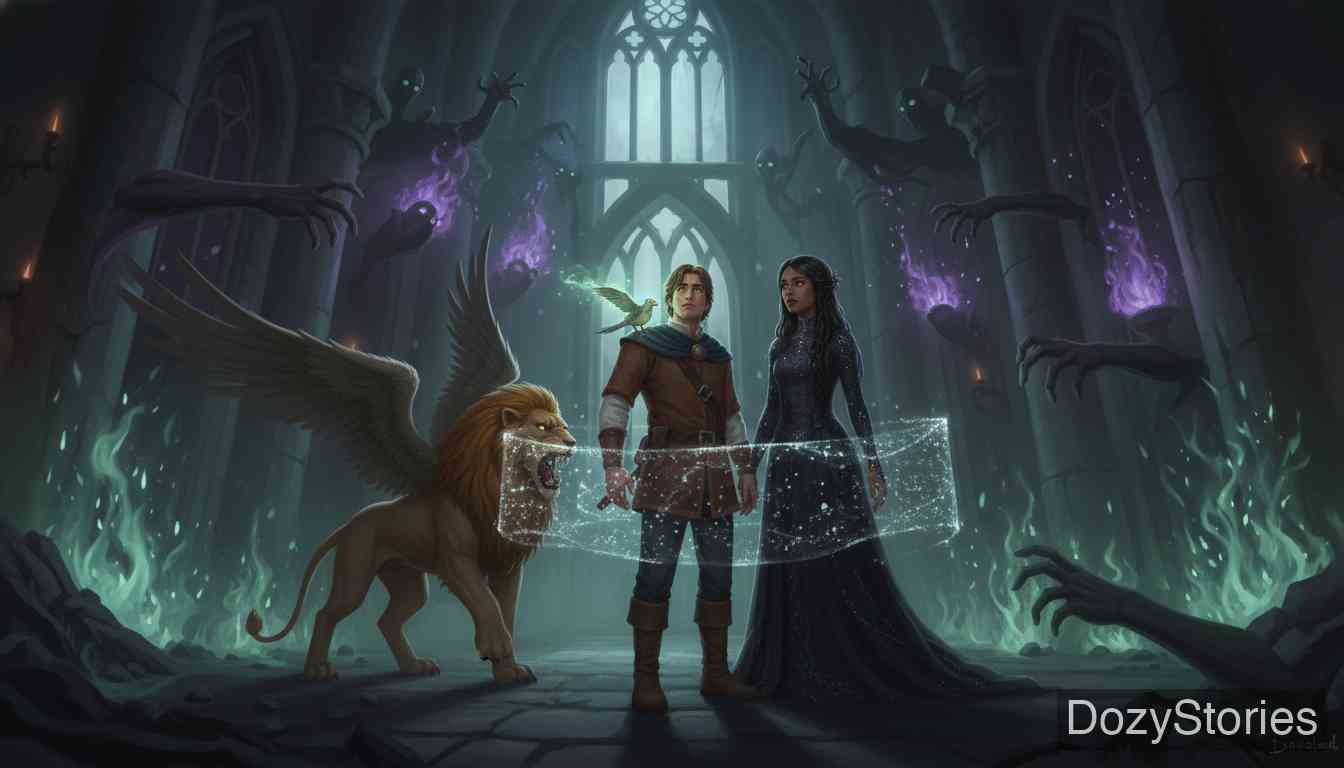
The maiden answered, "Thou must pass three nights in the great hall of this enchanted castle, but thou must let no fear enter thy heart. When they are doing their worst to torment thee, if thou bearest it without letting a sound escape thee, I shall be free. Thy life they dare not take."
Then said the King's son, "I have no fear; with God's help I will try it."
So he went gaily into the castle, and when it grew dark he seated himself in the large hall and waited.
Everything was quiet, however, till midnight, when all at once a great tumult began, and out of every hole and corner came little devils.
They behaved as if they did not see him, seated themselves in the middle of the room, lighted a fire, and began to gamble.
When one of them lost, he said, "It is not right; some one is here who does not belong to us; it is his fault that I am losing."
"Wait, you fellow behind the stove, I am coming," said another.
The screaming became still louder, so that no one could have heard it without terror.
The King's son stayed sitting quite quietly, and was not afraid; but at last the devils vanished, but he lay fainting there, and did not stir, nor could he raise his eyes to look at the maiden who came in, and sprinkled and bathed him with the water of life.
They dragged him about on the floor, pinched him, pricked him, beat him, and tormented him, but no sound escaped from him.
Towards morning they disappeared, and he was so exhausted that he could scarcely move his limbs, but when day dawned the black maiden came to him.
She bore in her hand a little bottle wherein was the water of life wherewith she washed him, and he at once felt all pain depart and new strength flow through his veins.
She said, "Thou hast held out successfully for one night, but two more lie before thee."
Then she went away again, and as she was going, he observed that her feet had become white.
The next night the devils came and began their gambols anew. They fell on the King's son, and beat him much more severely than the night before, until his body was covered with wounds.
But as he bore all quietly, they were forced to leave him, and when dawn appeared, the maiden came and healed him with the water of life.
And when she went away, he saw with joy that she had already become white to the tips of her fingers.
And now he had only one night more to go through, but it was the worst.
The hob-goblins came again: "Art thou there still?" cried they, "thou shalt be tormented till thy breath stops."
They pricked him and beat him, and threw him here and there, and pulled him by the arms and legs as if they wanted to tear him to pieces, but he bore everything, and never uttered a cry.
At last the devils vanished, but he lay fainting there, and did not stir, nor could he raise his eyes to look at the maiden who came in, and sprinkled and bathed him with the water of life.
But suddenly he was freed from all pain, and felt fresh and healthy as if he had awakened from sleep, and when he opened his eyes he saw the maiden standing by him, snow-white, and fair as day.
"Rise," said she, "and swing thy sword three times over the stairs, and then all will be delivered."
And when he had done that, the whole castle was released from enchantment, and the maiden was a rich King's daughter.
The servants came and said that the table was already set in the great hall, and dinner served up.
Then they sat down and ate and drank together, and in the evening the wedding was solemnized with great rejoicings.

Vocabulary from "The King's Son Who Feared Nothing"

12 key words from this story with definitions and original context sentences for language learners.

contentB1
/kənˈtent/adj.

Happy and satisfied with what one has.

满足的;满意的。

There was once a King's son, who was no longer content to stay at home in his father's house.

从前有一位国王的儿子,他不愿再满足于待在父亲家里。

enchanted(enchant)B1
/ɪnˈtʃɑːntɪd/adj.

Placed under a magic spell.

被施了魔法的;着了魔的。

It came to pass that he arrived before a castle which was enchanted.

后来他来到一座被施了魔法的城堡前。

admirationB2
/ˌædməˈreɪʃn/n.

A feeling of respect and approval.

钦佩;赞赏。

The giant came down and watched the bowling with great admiration.

巨人走下来,非常钦佩地看着他玩球。

railingB2
/ˈreɪlɪŋ/n.

A fence made of metal or wooden bars.

栏杆;围栏。

The garden in which the tree stands is surrounded by an iron railing.

那棵树所在的花园围着铁栏杆。

humblyB2
/ˈhʌmbli/adv.

In a modest, meek way, without pride.

谦卑地;恭顺地。

The lion sprang after him, not in rage and fierceness, but following him humbly as its master.

狮子跟在他身后,没有愤怒狂暴,而是谦卑地像跟随主人一样。

snatched(snatch)B2
/snætʃt/v.

Grabbed something quickly and roughly.

抢夺;一把抓住。

The giant instantly snatched the ring, and ran away with it.

巨人立刻抢过圆环逃跑了。

mercyB2
/ˈmɜːsi/n.

Kindness or forgiveness shown to someone in one's power.

仁慈;宽恕;怜悯。

The King's son thanked God for his great mercy, and travelled with his lion onwards.

王子感谢上帝的巨大恩慈,带着狮子继续游历。

betrothedC1
/bɪˈtrəʊðd/adj.

Engaged to be married.

已订婚的;已许配的。

I have a betrothed bride who wishes for it.

我有位未婚妻想要它。

prodigiousC1
/prəˈdɪdʒəs/adj.

Remarkably great in size, force, or degree.

巨大的;惊人的。

The ring closed tightly on his arm, and all at once he felt a prodigious strength flowing through his veins.

圆环紧紧套在他的手臂上,顿时他感到一股巨大的力量流遍全身。

stratagemC1
/ˈstrætədʒəm/n.

A clever trick or scheme to gain an advantage.

计谋;策略;诡计。

Then the giant thought of a stratagem, and said, "We will bathe in the river."

于是巨人想出一条毒计,说:'我们在河里洗个澡吧。'

falsehoodC1
/ˈfɔːlshʊd/n.

The telling of lies; deceit.

谎言;欺骗;虚假。

The King's son, who knew nothing of falsehood, went with him to the water.

不懂欺诈的王子随他去了水边。

precipiceC1
/ˈpresəpɪs/n.

A very steep, high cliff or drop.

悬崖;峭壁。

The faithful lion had not deserted its master; it held him fast and drew him back from the precipice.

忠诚的狮子没有抛弃主人,紧紧咬住他,把他从悬崖边拉了回来。

Reading Together & Learning More

The Moral

True bravery is not the absence of fear, but gritting your teeth and holding out in silence through the hardest hours. The prince prevails through endurance, faith, and a loyal heart that never abandons him (his lion) — brute strength can be beaten by cunning, but steadfastness and loyalty cannot.

Educational Value

Helps children tell bravery from recklessness and feel the power of perseverance; the faithful lion who saves its master again and again is a fine example for talking about trust and gratitude. The story also pairs well with 'The Youth Who Went Forth to Learn What Fear Was' — one cannot learn to fear, the other feels fear yet never cries out.

Tips for Parents

A gentle heads-up: the giant putting out the prince's eyes and the three nights of torment are fairly scary, better for older children. Talk with your child: the title says the prince 'feared nothing,' but does he survive the three nights by feeling no fear, or by bearing fear without crying out? What is the difference? Why does the faithful lion risk itself to save him again and again?

Talk About It

  1. The title says the prince 'feared nothing.' Which do you think counts more as courage: feeling no fear at all, or feeling fear yet bearing it without a cry?
  2. Unable to beat the ring-strengthened prince, the giant tricks the ring away with a 'let's bathe in the river' ploy. Why are honest, unguarded people easy to fool? Can we blame the prince for being too trusting?
  3. The faithful lion risks itself again and again — snatching back the ring, pulling its blinded master from the cliff, pushing the giant off the precipice. What makes it try so hard?
  4. After the prince is blinded, he regains his sight only through the hint of the bird bathing its eyes, and the brook's water. What do you think the story means to tell us with this?
  5. Freeing the princess means enduring three nights of torment without a single cry. If it were you, at which moment would it be hardest not to cry out?