The Golden Bird

Introduction

In folklore 'The Golden Bird' belongs to the tale type folklorists number ATU 550, and it has a far more famous cousin: the Russian 'Firebird.' In that story the prince's helper is a grey wolf, while in the Grimm version it becomes a fox—but the two follow almost exactly the same path. On the surface this is a treasure quest, yet its real thread is whether the hero will listen to advice. Again and again the fox tells him what to do, and again and again the young prince cannot resist something shinier—leaving the plain wooden cage for the golden one, the plain saddle for the golden one—and each time it goes wrong. The lesson for children is quiet but clear: a hunger for surface glitter tends to spoil the real task. The ending hides an ancient motif too: the faithful fox repeatedly begs the prince to cut off its head and feet, and only when the kind-hearted prince finally does so is the fox changed back into a man—the princess's own brother, released from a spell. This 'beheading to break enchantment' is one of the oldest forms of disenchantment in European folktales; harsh as it sounds, it stands for the death of an old shape and the birth of a new one. As you read, watch the fox closely: is he only an animal, or something more?

Font Size
Image Layout
1 / 72
Stopped
In times gone by there was a king who had at the back of his castle a beautiful pleasure-garden, in which stood a tree that bore golden apples.
As the apples ripened they were counted, but one morning one was missing. Then the king was angry, and he ordered that watch should be kept about the tree every night.
Now the king had three sons, and he sent the eldest to spend the whole night in the garden; so he watched till midnight, and then he could keep off sleep no longer, and in the morning another apple was missing.
The second son had to watch the following night; but it fared no better, for when twelve o'clock had struck he went to sleep, and in the morning another apple was missing.
Now came the turn of the third son to watch, and he was ready to do so; but the king had less trust in him, and believed he would acquit himself still worse than his brothers, but in the end he consented to let him try.
So the young man lay down under the tree to watch, and resolved that sleep should not be master.
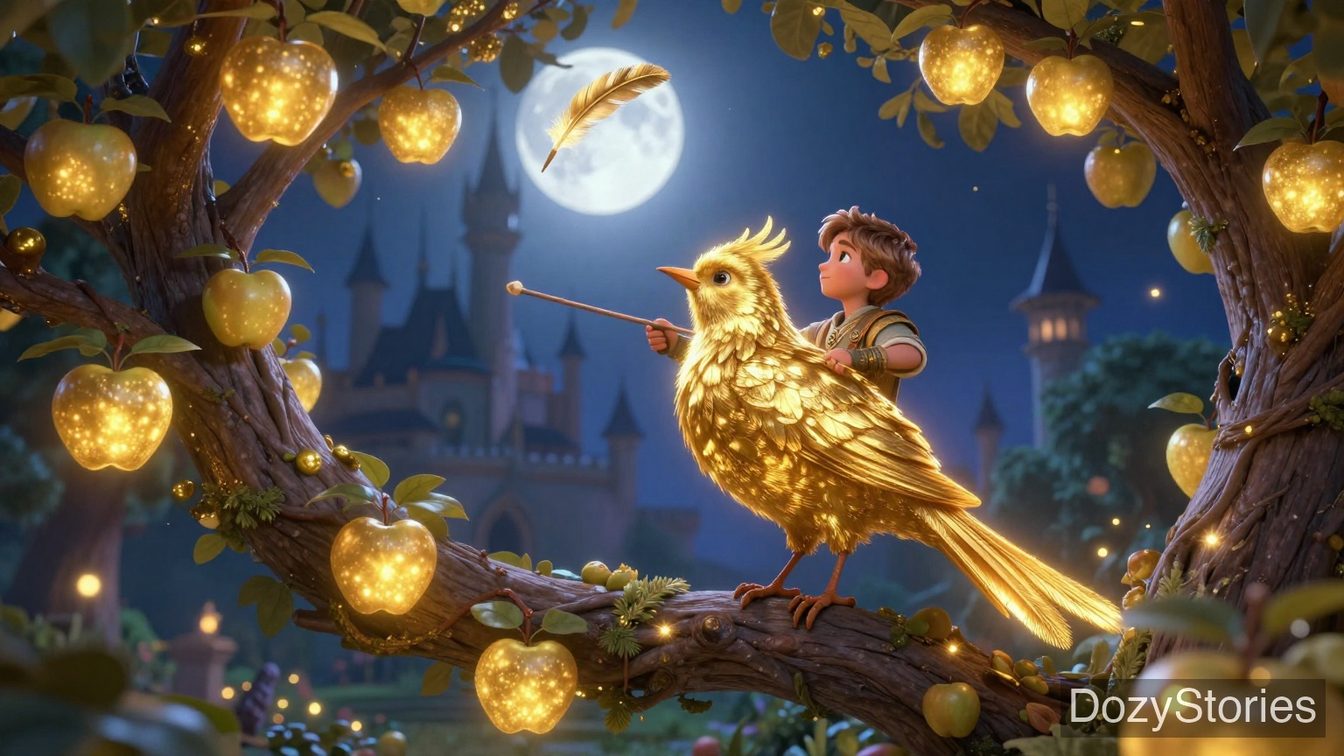
When it struck twelve something came rushing through the air, and he saw in the moonlight a bird flying towards him, whose feathers glittered like gold.
The bird perched upon the tree, and had already pecked off an apple, when the young man let fly an arrow at it.
The bird flew away, but the arrow had struck its plumage, and one of its golden feathers fell to the ground: the young man picked it up, and taking it next morning to the king, told him what had happened in the night.
The king called his council together, and all declared that such a feather was worth more than the whole kingdom.
'Since the feather is so valuable,' said the king, 'one is not enough for me; I must and will have the whole bird.'
So the eldest son set off, and relying on his own cleverness he thought he should soon find the golden bird.
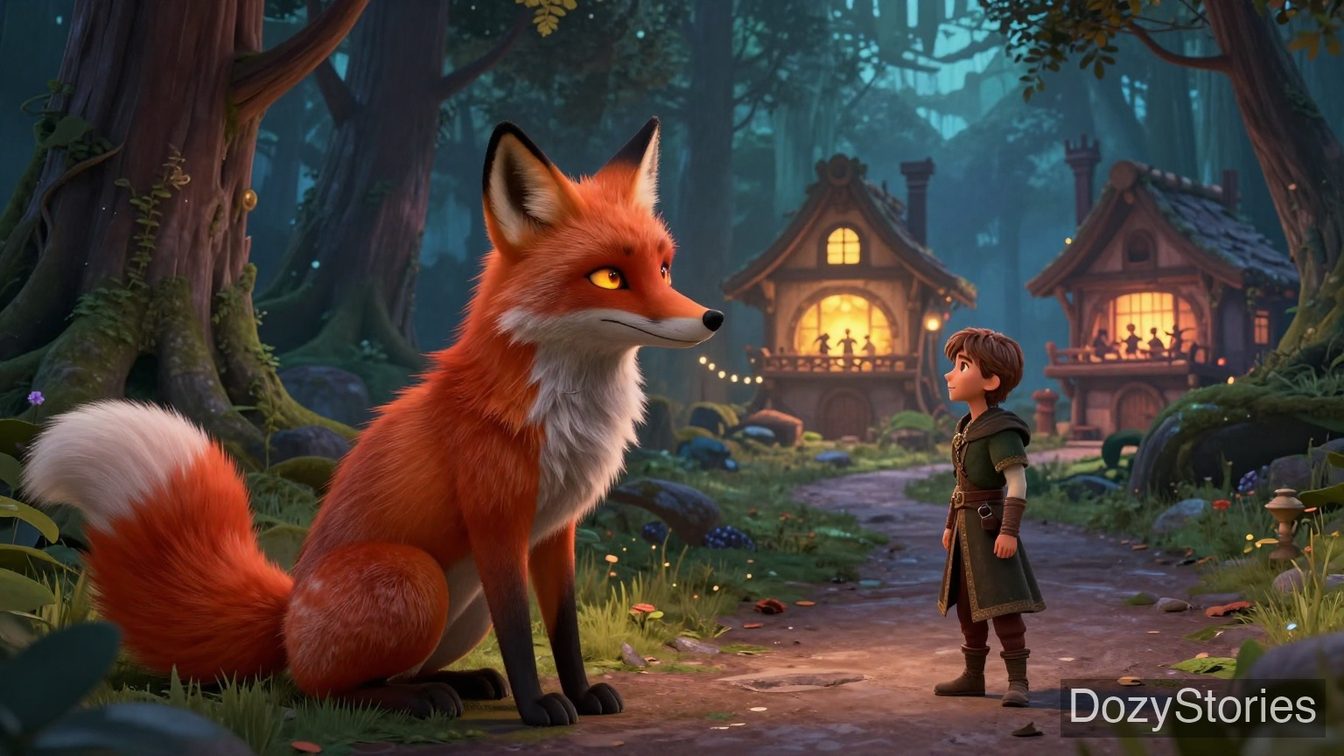
When he had gone some distance he saw a fox sitting at the edge of a wood, and he pointed his gun at him.
The fox cried out, 'Do not shoot me, and I will give you good counsel. You are on your way to find the golden bird, and this evening you will come to a village, in which two taverns stand facing each other. One will be brightly lighted up, and there will be plenty of merriment going on inside; do not mind about that, but go into the other one, although it will look to you very uninviting.'
'How can a silly beast give one any rational advice?' thought the king's son and let fly at the fox, but missed him, and he stretched out his tail and ran quick into the wood.
Then the young man went on his way, and towards evening he came to the village, and there stood the two taverns; in one singing and dancing was going on, the other looked quite dull and wretched.
'I should be a fool,' said he, 'to go into that dismal place, while there is anything so good close by.' So he went into the merry inn, and there lived in clover, quite forgetting the bird and his father, and all good counsel.
As time went on, and the eldest son never came home, the second son set out to seek the golden bird.
He met with the fox, just as the eldest did, and received good advice from him without attending to it.
And when he came to the two taverns, his brother was standing and calling to him at the window of one of them, out of which came sounds of merriment; so he could not resist, but went in and revelled to his heart's content.
And then, as time went on, the youngest son wished to go forth, and to try his luck, but his father would not consent.
'It would be useless,' said he; 'he is much less likely to find the bird than his brothers, and if any misfortune were to happen to him he would not know how to help himself; his wits are none of the best.' But at last, as there was no peace to be had, he let him go.
By the side of the wood sat the fox, begged him to spare his life, and gave him good counsel. The young man was kind, and said, 'Be easy, little fox, I will do you no harm.'
'You shall not repent of it,' answered the fox, 'and that you may get there all the sooner, get up and sit on my tail.' And no sooner had he done so than the fox began to run, and off they went over stock and stone, so that the wind whistled in their hair.
When they reached the village the young man got down, and, following the fox's advice, went into the mean-looking tavern, without hesitating, and there he passed a quiet night.
The next morning, when he went out into the field, the fox, who was sitting there already, said, 'I will tell you further what you have to do. Go straight on until you come to a castle, before which a great band of soldiers lie, but do not trouble yourself about them, for they will be all asleep and snoring; pass through them and forward into the castle, and go through all the rooms, until you come to one where there is a golden bird hanging in a wooden cage. Near at hand will stand empty a golden cage of state, but you must beware of taking the bird out of his ugly cage and putting him into the fine one; if you do so you will come to harm.'
And when the king's son reached the castle he found everything as the fox had said: and he at last entered the room where the golden bird was hanging in a wooden cage, while a golden one was standing by; the three golden apples too were in the room.
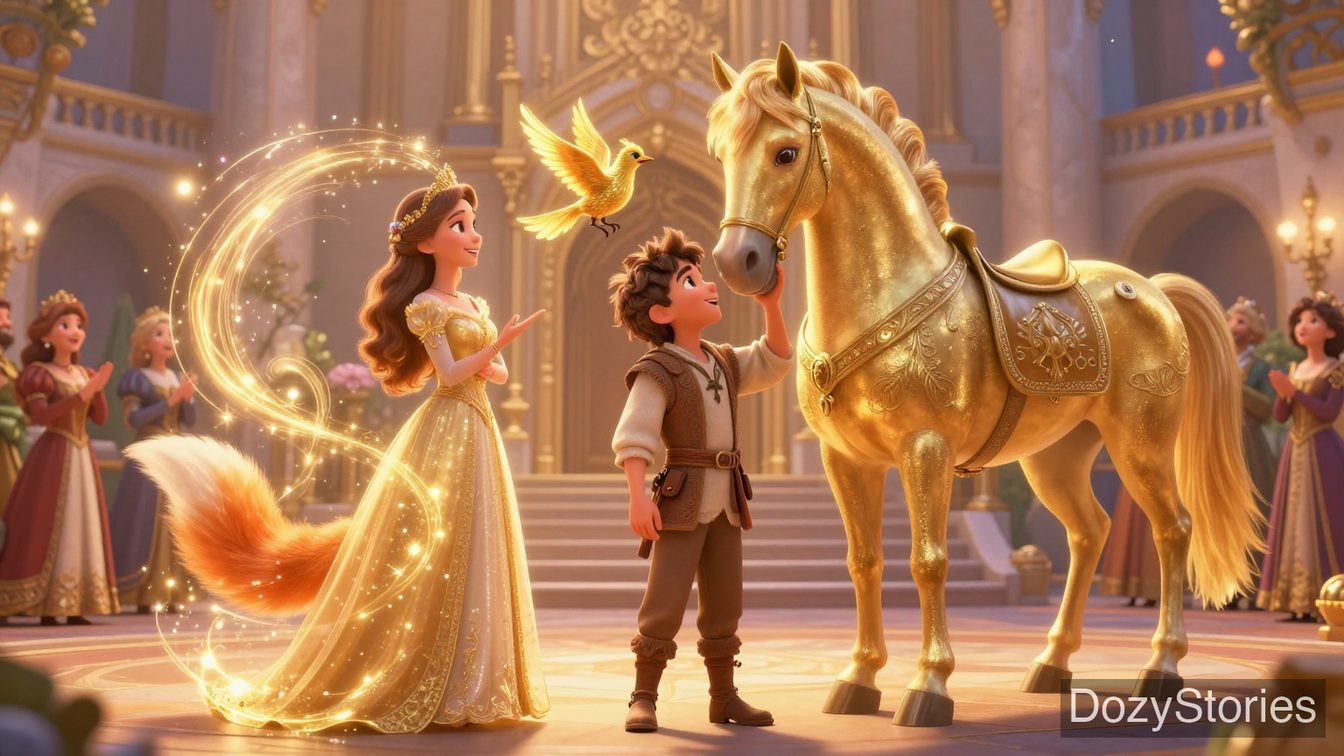
Then, thinking it foolish to let the beautiful bird stay in that mean and ugly cage, he opened the door of it, took hold of it, and put it in the golden one.
In the same moment the bird uttered a piercing cry. The soldiers awaked, rushed in, seized the king's son and put him in prison.
The next morning he was brought before a judge, and, as he confessed everything, condemned to death. But the king said he would spare his life on one condition, that he should bring him the golden horse whose paces were swifter than the wind, and that then he should also receive the golden bird as a reward.
So the king's son set off to find the golden horse, but he sighed, and was very sad, for how should it be accomplished? And then he saw his old friend the fox sitting by the roadside.
'Now, you see,' said the fox, 'all this has happened, because you would not listen to me. But be of good courage, I will bring you through, and will tell you how you are to get the golden horse. You must go straight on until you come to a castle, where the horse stands in his stable; before the stable-door the grooms will be lying, but they will all be asleep and snoring; and you can go and quietly lead out the horse. But one thing you must mind - take care to put upon him the plain saddle of wood and leather, and not the golden one, which will hang close by; otherwise it will go badly with you.'
And everything happened just as the fox had said, and he came to the stall where the golden horse was: and as he was about to put on him the plain saddle, he thought to himself, 'Such a beautiful animal would be disgraced were I not to put on him the good saddle, which becomes him so well.'
However, no sooner did the horse feel the golden saddle touch him than he began to neigh. And the grooms all awoke, seized the king's son and threw him into prison.
The next morning he was delivered up to justice and condemned to death, but the king promised him his life, and also to bestow upon him the golden horse, if he could convey thither the beautiful princess of the golden castle.
With a heavy heart the king's son set out, but by great good luck he soon met with the faithful fox.
'I ought now to leave you to your own ill-luck,' said the fox, 'but I am sorry for you, and will once more help you in your need. Your way lies straight up to the golden castle: you will arrive there in the evening, and at night, when all is quiet, the beautiful princess goes to the bath. And as she is entering the bathing-house, go up to her and give her a kiss, then she will follow you, and you can lead her away; but do not suffer her first to go and take leave of her parents, or it will go ill with you.'
And when he came to the golden castle, all was as the fox had said. He waited until midnight, when all lay in deep sleep, and then as the beautiful princess went to the bathing-house he went up to her and gave her a kiss, and she willingly promised to go with him, but she begged him earnestly, and with tears, that he would let her first go and take leave of her parents.
At first he denied her prayer, but as she wept so much the more, and fell at his feet, he gave in at last.
And no sooner had the princess reached her father's bedside than he, and all who were in the castle, waked up, and the young man was seized and thrown into prison.
The next morning the king said to him, 'Thy life is forfeit, but thou shalt find grace if thou canst level that mountain that lies before my windows, and over which I am not able to see: and if this is done within eight days thou shalt have my daughter for a reward.'
So the king's son set to work, and dug and shovelled away without ceasing, but when, on the seventh day, he saw how little he had accomplished, and that all his work was as nothing, he fell into great sadness, and gave up all hope.
But on the evening of the seventh day the fox appeared, and said, 'You do not deserve that I should help you, but go now and lie down to sleep, and I will do the work for you.'
The next morning when he awoke, and looked out of the window, the mountain had disappeared. The young man hastened full of joy to the king, and told him that his behest was fulfilled, and, whether the king liked it or not, he had to keep to his word, and let his daughter go.
So they both went away together, and it was not long before the faithful fox came up to them.
'Well, you have got the best first,' said he; 'but you must know the golden horse belongs to the princess of the golden castle.' 'But how shall I get it?' asked the young man. 'I am going to tell you,' answered the fox. 'First, go to the king who sent you to the golden castle, and take to him the beautiful princess. There will then be very great rejoicing; he will willingly give you the golden horse, and they will lead him out to you; then mount him without delay, and stretch out your hand to each of them to take leave, and last of all to the princess, and when you have her by the hand swing her up on the horse behind you, and off you go! nobody will be able to overtake you, for that horse goes swifter than the wind.'
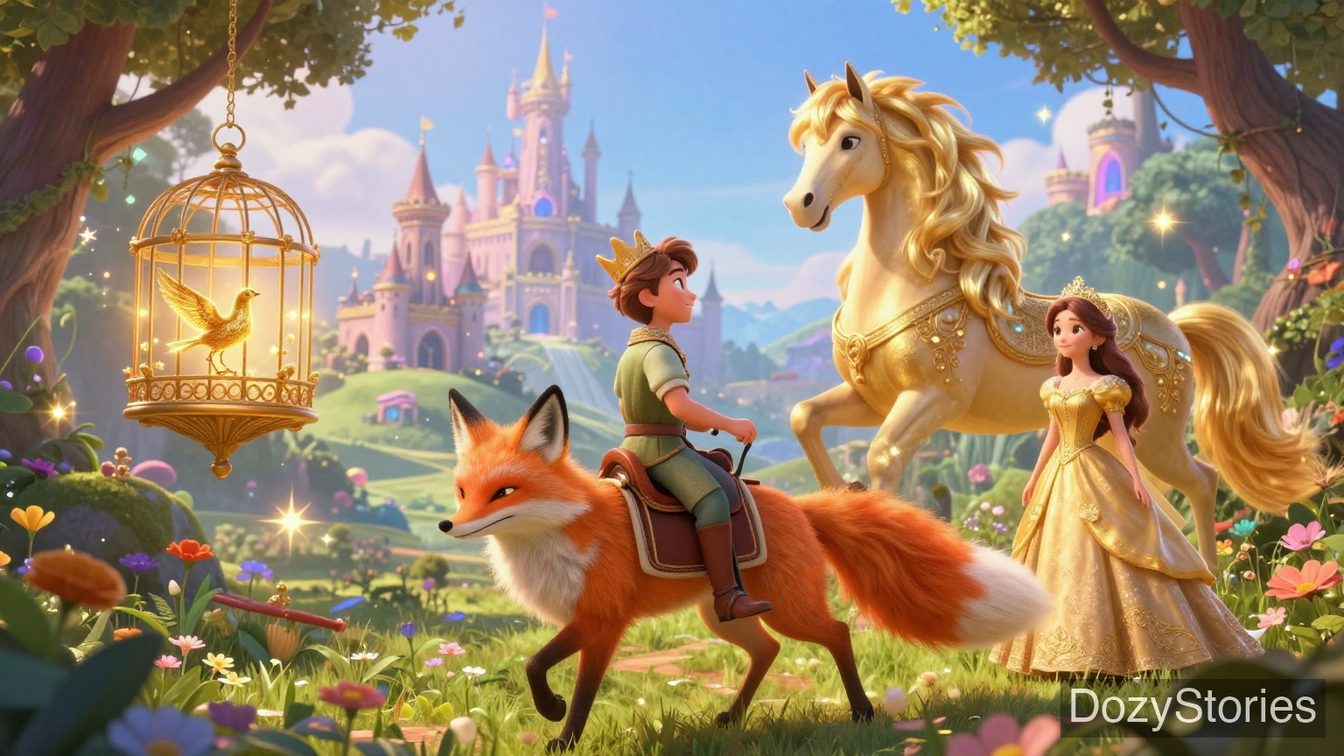
And so it was all happily done, and the king's son carried off the beautiful princess on the golden horse.
The fox did not stay behind, and he said to the young man, 'Now, I will help you to get the golden bird. When you draw near the castle where the bird is, let the lady alight, and I will take her under my care; then you must ride the golden horse into the castle-yard, and there will be great rejoicing to see it, and they will bring out to you the golden bird; as soon as you have the cage in your hand, you must start off back to us, and then you shall carry the lady away.'
The plan was successfully carried out; and when the young man returned with the treasure, the fox said, 'Now, what will you give me for my reward?'
'What would you like?' asked the young man. 'When we are passing through the wood, I desire that you should slay me, and cut my head and feet off.'
'That were a strange sign of gratitude,' said the king's son, 'and I could not possibly do such a thing.' Then said the fox, 'If you will not do it, I must leave you; but before I go let me give you some good advice. Beware of two things: buy no gallows-meat, and sit at no brook-side.' With that the fox ran off into the wood.
The young man thought to himself, 'That is a wonderful animal, with most singular ideas. How should any one buy gallows-meat? and I am sure I have no particular fancy for sitting by a brook-side.'
So he rode on with the beautiful princess, and their way led them through the village where his two brothers had stayed. There they heard great outcry and noise, and when he asked what it was all about, they told him that two people were going to be hanged.
And when he drew near he saw that it was his two brothers, who had done all sorts of evil tricks, and had wasted all their goods. He asked if there were no means of setting them free.
'Oh yes! if you will buy them off,' answered the people; 'but why should you spend your money in redeeming such worthless men?' But he persisted in doing so; and when they were let go they all went on their journey together.
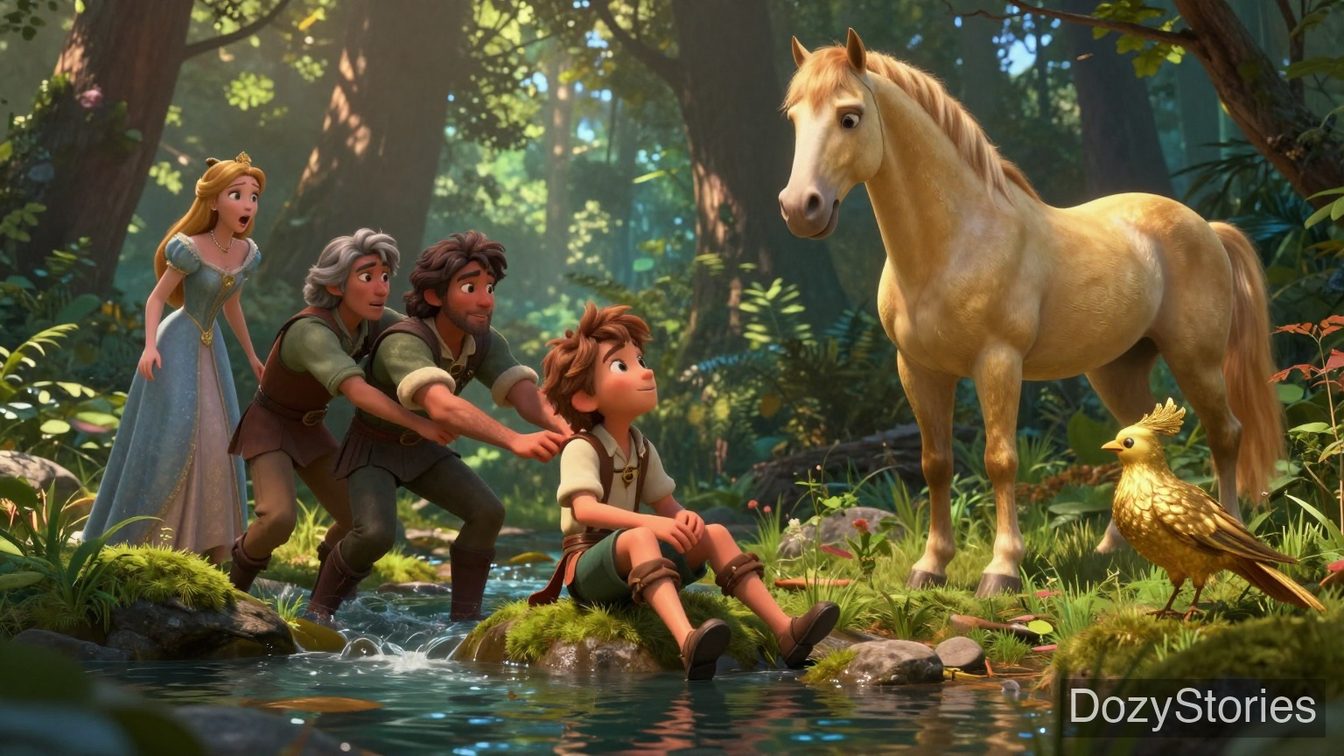
After a while they came to the wood where the fox had met them first, and there it seemed so cool and sheltered from the sun's burning rays that the two brothers said, 'Let us rest here for a little by the brook, and eat and drink to refresh ourselves.'
The young man consented, quite forgetting the fox's warning, and he seated himself by the brook-side, suspecting no evil.
But the two brothers thrust him backwards into the brook, seized the princess, the horse, and the bird, and went home to their father.
'Is not this the golden bird that we bring?' said they; 'and we have also the golden horse, and the princess of the golden castle.' Then there was great rejoicing in the royal castle, but the horse did not feed, the bird did not chirp, and the princess sat still and wept.
The youngest brother, however, had not perished. The brook was, by good fortune, dry, and he fell on soft moss without receiving any hurt, but he could not get up again.
But in his need the faithful fox was not lacking; he came up running, and reproached him for having forgotten his advice.
'But I cannot forsake you all the same,' said he; 'I will help you back again into daylight.' So he told the young man to grasp his tail, and hold on to it fast, and so he drew him up again.
'Still you are not quite out of all danger,' said the fox; 'your brothers, not being certain of your death, have surrounded the wood with sentinels, who are to put you to death if you let yourself be seen.'
A poor beggar-man was sitting by the path, and the young man changed clothes with him, and went clad in that wise into the king's courtyard.
Nobody knew him, but the bird began to chirp, and the horse began to feed, and the beautiful princess ceased weeping.
'What does this mean?' said the king, astonished. The princess answered, 'I cannot tell, except that I was sad, and now I am joyful; it is to me as if my rightful bridegroom had returned.'
Then she told him all that happened, although the two brothers had threatened to put her to death if she let out anything.
The king then ordered every person in the castle to be brought before him, and with the rest came the young man like a beggar in his wretched garments; but the princess knew him, and greeted him well, falling on his neck and kissing him.
The wicked brothers were seized and put to death, and the youngest brother was married to the princess, and succeeded to the inheritance of his father.
But what became of the poor fox? Long afterwards the king's son was going through the wood, and the fox met him and said, 'Now, you have everything that you can wish for, but my misfortunes never come to an end, and it lies in your power to free me from them.'
And once more he prayed the king's son earnestly to slay him, and cut off his head and feet. So, at last, he consented, and no sooner was it done than the fox was changed into a man, and was no other than the brother of the beautiful princess; and thus he was set free from a spell that had bound him for a long, long time.
And now, indeed, there lacked nothing to their happiness as long as they lived.

Vocabulary from "The Golden Bird"

12 key words from this story with definitions and original context sentences for language learners.

ripened(ripen)B2
/ˈraɪpənd/v.

(Of fruit or crops) became fully grown and ready to eat.

(水果、庄稼)成熟;变熟。

As the apples ripened they were counted, but one morning one was missing.

苹果成熟时都要点数,但有一天早上少了一个。

resolved(resolve)B2
/rɪˈzɒlvd/v.

Made a firm decision to do something.

下定决心;决意(做某事)。

So the young man lay down under the tree to watch, and resolved that sleep should not be master.

于是年轻人躺在树下看守,决心不让睡眠主宰自己。

plumageC1
/ˈpluːmɪdʒ/n.

The feathers covering a bird's body.

鸟的羽毛(全身的羽毛)。

The bird flew away, but the arrow had struck its plumage, and one of its golden feathers fell to the ground.

鸟儿飞走了,但箭击中了它的羽毛,一根金羽毛掉落在地。

counselC1
/ˈkaʊnsl/n.

Advice, especially serious advice given carefully.

忠告;劝告;建议。

The fox cried out, 'Do not shoot me, and I will give you good counsel.'

狐狸喊道:'别射我,我会给你好建议。'

tavernB2
/ˈtævərn/n.

An old-fashioned place where people go to drink and sometimes stay the night; an inn.

(旧时的)小酒馆;客栈。

This evening you will come to a village, in which two taverns stand facing each other.

今晚你会来到一个村庄,那里有两家酒馆面对面而立。

merrimentC1
/ˈmerimənt/n.

Happiness, laughter and fun.

欢乐;欢闹;嬉笑作乐。

One will be brightly lighted up, and there will be plenty of merriment going on inside.

一家灯火通明,里面充满欢乐。

uninvitingB2
/ˌʌnɪnˈvaɪtɪŋ/adj.

Not attractive or pleasant; not making you want to go in or take part.

不吸引人的;不讨人喜欢的;令人却步的。

Go into the other one, although it will look to you very uninviting.

去另一家,虽然它看起来很不吸引人。

wretchedC1
/ˈretʃɪd/adj.

Very poor, miserable, or in a bad condition.

破败的;凄惨的;可怜的。

In one singing and dancing was going on, the other looked quite dull and wretched.

一家在唱歌跳舞,另一家看起来十分破败。

piercingB2
/ˈpɪərsɪŋ/adj.

(Of a sound) very sharp, loud and high, so that it seems to go through you.

(声音)刺耳的;尖利的;穿透力强的。

In the same moment the bird uttered a piercing cry.

就在这一刻,鸟儿发出刺耳的叫声。

neighB2
/neɪ/v.

(Of a horse) to make its long, loud, high-pitched cry.

(马)嘶鸣;嘶叫。

No sooner did the horse feel the golden saddle touch him than he began to neigh.

然而,金马一感觉到金鞍就嘶鸣起来。

gratitudeB2
/ˈɡrætɪtjuːd/n.

The feeling of being thankful for something someone has done for you.

感激;感恩之情。

'That were a strange sign of gratitude,' said the king's son.

'那是奇怪的感恩方式,'国王的儿子说。

reproached(reproach)C1
/rɪˈprəʊtʃt/v.

Blamed or criticised someone, showing disappointment in them.

责备;数落;埋怨。

He came up running, and reproached him for having forgotten his advice.

忠实的狐狸出现了,责备他忘记了自己的忠告。

Reading Together & Learning More

The Moral

Kindness and a willingness to heed good advice carry us further than our own cleverness, and true goodness is repaid when we least expect it.

Educational Value

Nurtures a child's sense of heeding advice and resisting temptation, and an appreciation of kindness and gratitude; the repeating pattern—each shinier choice makes things worse—also helps children practise predicting outcomes and reasoning about cause and effect.

Tips for Parents

Each time the prince is about to ignore the fox's advice, pause and ask your child, 'What do you think will happen next?'—letting them feel the link between a choice and its consequence.

Talk About It

  1. The fox warns the prince time after time, yet he cannot resist reaching for the shinier cage and saddle. Can you understand why he gives in? Would you?
  2. The elder brothers point a gun at the fox, but the youngest is kind to it. Why do you think these two attitudes lead to such different endings?
  3. After his brothers throw him into the brook and steal everything, the prince still pays to save them from being hanged. Do you think that was worth doing?
  4. In the end the fox asks the prince to cut off its head so it can become human again. Could you do such a thing to a friend who had helped you?
  5. The youngest son, the one his father trusted least, is the one who succeeds. What do you think makes him different from his brothers?