The Gnome

Introduction

This is one of the most classic adventure skeletons in all the world's storytelling, catalogued by folklorists as ATU 301 and often called the 'Three Stolen Princesses' or 'Bear's Son' type. You may have met its pattern in many tales: a looked-down-upon young man (here, 'Stupid Hans') is lowered by rope or basket into an underworld, slays monsters and frees captives, only to be cut loose halfway by glory-hungry companions, and must find another strange way back (here, a flute that summons earth-elves). Scholars often see this 'descent into the monster's lair and return' structure as a folk cousin of the hero's dive into the underwater den in the Old English epic Beowulf. Two charming old conventions hide inside the story: the princesses, sworn not to reveal the truth, tell it 'to the stove' so the King listening at the door can overhear — the same folk wisdom as the barber whispering King Midas's donkey-ears into a hole in the ground; and at the end the narrator solemnly claims he wore glass shoes at the wedding that went 'Klink' and broke when he kicked a stone — a stock joke-ending of German 'tall-tale' storytelling, a wink to the child that this was, after all, only a story.

Font Size
Image Layout
1 / 20
Stopped
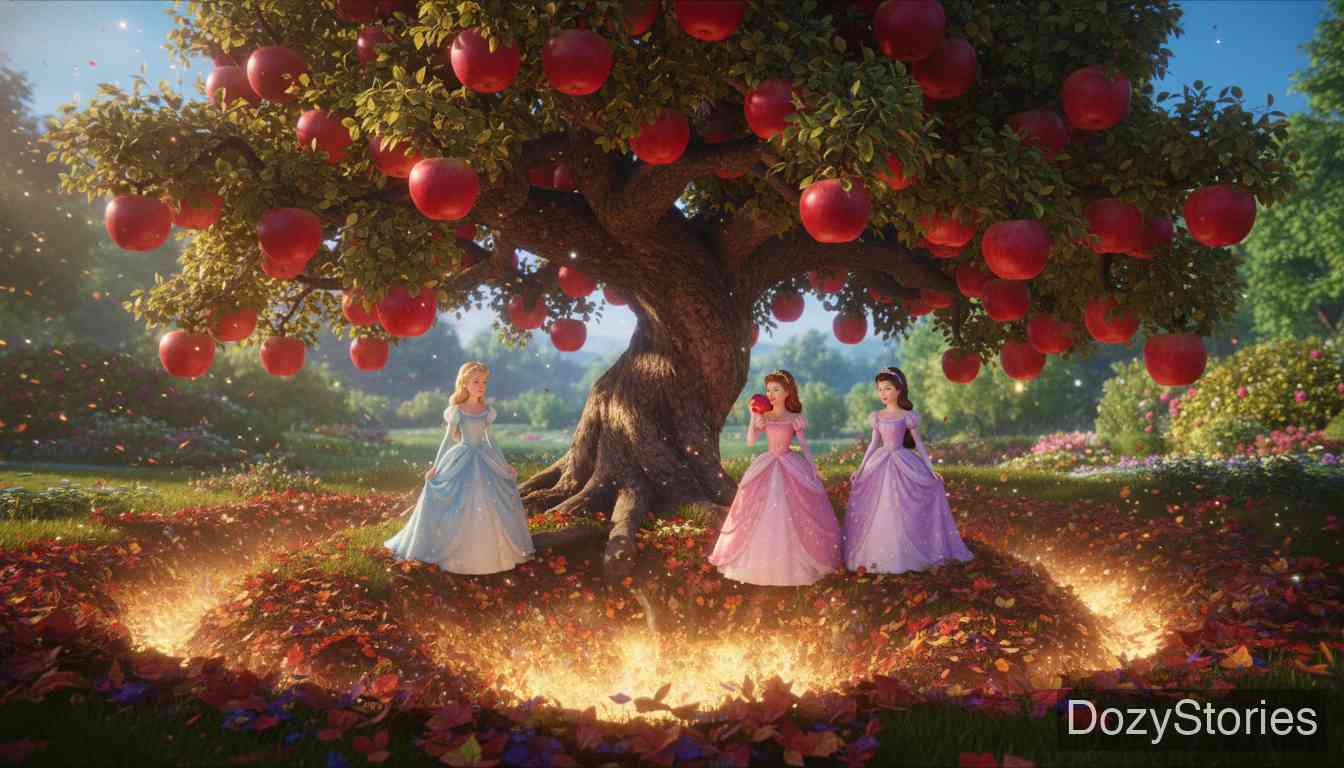
There was once upon a time a rich King who had three daughters, who daily went to walk in the palace garden, and the King was a great lover of all kinds of fine trees, but there was one for which he had such an affection, that if anyone gathered an apple from it he wished him a hundred fathoms underground.
And when harvest time came, the apples on this tree were all as red as blood. The three daughters went every day beneath the tree, and looked to see if the wind had not blown down an apple, but they never by any chance found one, and the tree was so loaded with them that it was almost breaking, and the branches hung down to the ground. Then the King's youngest child had a great desire for an apple, and said to her sisters, "Our father loves us far too much to wish us underground, it is my belief that he would only do that to people who were strangers."
And while she was speaking, the child plucked off quite a large apple, and ran to her sisters, saying, "Just taste, my dear little sisters, for never in my life have I tasted anything so delightful." Then the two other sisters also ate some of the apple, whereupon all three sank deep down into the earth, where they could hear no cock crow.
When mid-day came, the King wished to call them to come to dinner, but they were nowhere to be found. He sought them everywhere in the palace and garden, but could not find them. Then he was much troubled, and made known to the whole land that whosoever brought his daughters back again should have one of them to wife.
Hereupon so many young men went about the country in search, that there was no counting them, for every one loved the three children because they were so kind to all, and so fair of face. Three young huntsmen also went out, and when they had travelled about for eight days, they arrived at a great castle, in which were beautiful apartments, and in one room a table was laid on which were delicate dishes which were still so warm that they were smoking, but in the whole of the castle no human being was either to be seen or heard.
They waited there for half a day, and the food still remained warm and smoking, and at length they were so hungry that they sat down and ate, and agreed with each other that they would stay and live in that castle, and that one of them, who should be chosen by casting lots, should remain in the house, and the two others seek the King's daughters. They cast lots, and the lot fell on the eldest; so next day the two younger went out to seek, and the eldest had to stay home.
At mid-day came a small, small mannikin and begged for a piece of bread, then the huntsman took the bread which he had found there, and cut a round off the loaf and was about to give it to him, but whilst he is giving it to the mannikin, the latter let it fall, and asked the huntsman to be so good as to give him that piece again. The huntsman was about to do so and stooped, on which the mannikin took a stick, seized him by the hair, and gave him a good beating. Next day, the second stayed at home, and he fared no better. When the two others returned in the evening, the eldest said, "Well, how have you got on?"
"Oh, very badly," said he, and then they lamented their misfortune together, but they said nothing about it to the youngest, for they did not like him at all, and always called him Stupid Hans, because he did not exactly belong to the forest.
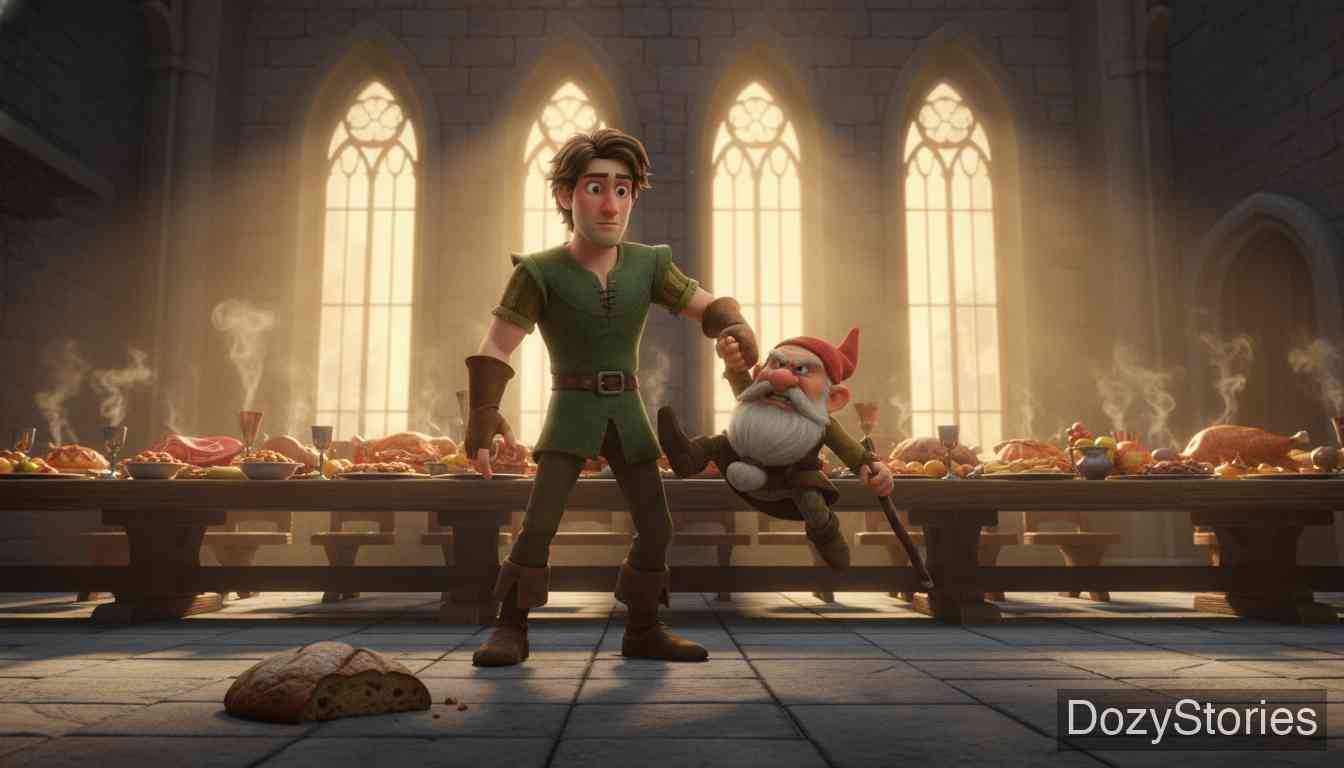
On the third day, the youngest stayed at home, and again the little mannikin came and begged for a piece of bread. When the youth gave it to him, the elf let it fall as before, and asked him to be so good as to give him that piece again. Then said Hans to the little mannikin, "What! canst thou not pick up that piece thyself? If thou wilt not take as much trouble as that for thy daily bread, thou dost not deserve to have it."
Then the mannikin grew very angry and said he was to do it, but the huntsman would not, and took my dear mannikin, and gave him a thorough beating. Then the mannikin screamed terribly, and cried, "Stop, stop, and let me go, and I will tell thee where the King's daughters are." When Hans heard that, he left off beating him and the mannikin told him that he was an earth mannikin, and that there were more than a thousand like him, and that if he would go with him he would show him where the King's daughters were.
Then he showed him a deep well, but there was no water in it. And the elf said that he knew well that the companions Hans had with him did not intend to deal honourably with him, therefore if he wished to deliver the King's children, he must do it alone. The two other brothers would also be very glad to recover the King's daughters, but they did not want to have any trouble or danger. Hans was therefore to take a large basket, and he must seat himself in it with his hanger and a bell, and be let down.
Below were three rooms, and in each of them was a princess, with a many-headed dragon, whose heads she was to comb and trim, but he must cut them off. And having said all this, the elf vanished. When it was evening the two brothers came and asked how he had got on, and he said, "pretty well so far," and that he had seen no one except at mid-day when a little mannikin had come and begged for a piece of bread, that he had given some to him, but that the mannikin had let it fall and had asked him to pick it up again; but as he did not choose to do that, the elf had begun to lose his temper, and that he had done what he ought not, and that he had given the elf a beating, on which he had told him where the King's daughters were.
Then the two were so angry at this that they grew green and yellow. Next morning they went to the well together, and drew lots who should first seat himself in the basket, and again the lot fell on the eldest, and he was to seat himself in it, and take the bell with him. Then he said, "If I ring, you must draw me up again immediately." When he had gone down for a short distance, he rang, and they at once drew him up again. Then the second seated himself in the basket, but he did just the same as the first, and then it was the turn of the youngest, but he let himself be lowered quite to the bottom.
When he had got out of the basket, he took his hanger, and went and stood outside the first door and listened, and heard the dragon snoring quite loudly. He opened the door slowly, and one of the princesses was sitting there, and had nine dragon's heads lying upon her lap, and was combing them. Then he took his hanger and hewed at them, and the nine fell off. The princess sprang up, threw her arms round his neck, embraced and kissed him repeatedly, and took her stomacher, which was made of pure gold, and hung it round his neck.
Then he went to the second princess, who had a dragon with five heads to comb, and delivered her also, and to the youngest, who had a dragon with four heads, he went likewise. And they all rejoiced, and embraced him and kissed him without stopping.
Then he rang very loud, so that those above heard him, and he placed the princesses one after the other in the basket, and had them all drawn up, but when it came to his own turn he remembered the words of the elf, who had told him that his comrades did not mean well by him. So he took a great stone which was lying there, and placed it in the basket, and when it was about half way up, his false brothers above cut the rope, so that the basket with the stone fell to the ground, and they thought that he was dead, and ran away with the three princesses, making them promise to tell their father that it was they who had delivered them, and then they went to the King, and each demanded a princess in marriage.
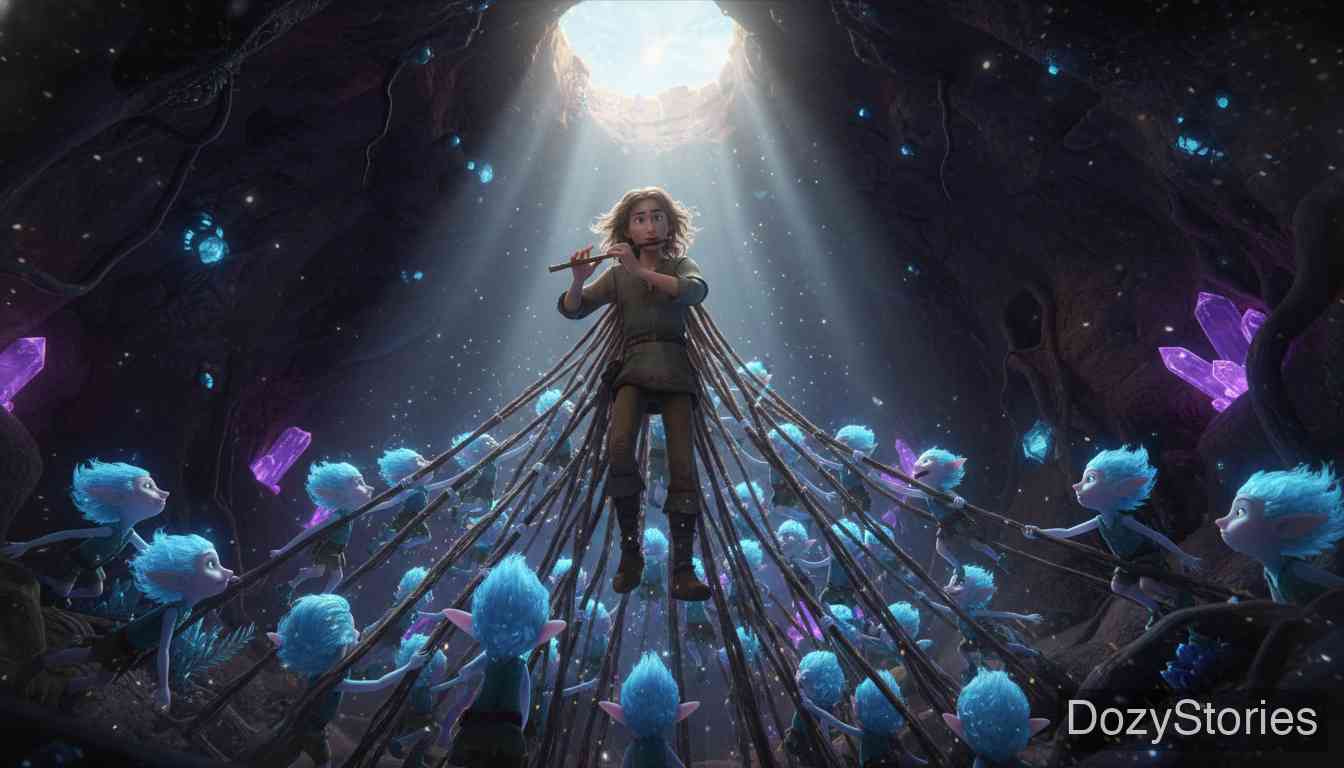
In the meantime the youngest huntsman was wandering about the three chambers in great trouble, fully expecting to have to end his days there, when he saw, hanging on the wall, a flute; then said he, "Why dost thou hang there, no one can be merry here?" He looked at the dragons, heads likewise and said, "You too cannot help me now." He walked backwards and forwards for such a long time that he made the surface of the ground quite smooth.
But at last other thoughts came to his mind, and he took the flute from the wall, and played a few notes on it, and suddenly a number of elves appeared, and with every note that he sounded one more came. Then he played until the room was entirely filled. They all asked what he desired, so he said he wished to get above ground back to daylight, on which they seized him by every hair that grew on his head, and thus they flew with him onto the earth again.
When he was above ground, he at once went to the King's palace, just as the wedding of one princess was about to be celebrated, and he went to the room where the King and his three daughters were. When the princesses saw him they fainted. Hereupon the King was angry, and ordered him to be put in prison at once, because he thought he must have done some injury to the children.
When the princesses came to themselves, however, they entereated the King to set him free again. The King asked why, and they said that they were not allowed to tell that, but their father said that they were to tell it to the stove. And he went out, listened at the door, and heard everything. Then he caused the two brothers to be hanged on the gallows, and to the third he gave his youngest daughter, and on that occasion I wore a pair of glass shoes, and I struck them against a stone, and they said, "Klink," and were broken.

Vocabulary from "The Gnome"

12 key words from this story with definitions and original context sentences for language learners.

fathoms(fathom)C1
/ˈfæðəmz/n.

Units of depth equal to about 1.8 metres, used to measure deep water or, here, depth underground.

英寻(约1.8米的深度单位,用于测量深水或此处的地下深度)。

If anyone gathered an apple from it he wished him a hundred fathoms underground.

任何摘下这棵树上苹果的人,他都希望其沉入地下深处。

affectionB1
/əˈfekʃn/n.

A feeling of fondness or gentle love.

喜爱;钟爱;深情。

There was one for which he had such an affection.

但其中有一棵他特别喜爱。

plucked(pluck)B2
/plʌkt/v.

Pulled or picked something quickly, especially fruit or flowers.

摘;采(尤指果实或花)。

The child plucked off quite a large apple, and ran to her sisters.

这孩子摘下一个很大的苹果,跑向姐姐们。

lamented(lament)C1
/ləˈmentɪd/v.

Expressed deep sorrow or regret about something.

悲叹;哀叹;痛惜。

Then they lamented their misfortune together.

然后他们一起哀叹不幸。

stooped(stoop)B2
/stuːpt/v.

Bent the upper body forward and downward.

弯腰;俯身。

The huntsman was about to do so and stooped, on which the mannikin took a stick.

猎人正要弯腰去捡,小矮人拿起一根棍子。

snoring(snore)B1
/ˈsnɔːrɪŋ/v.

Making a rough, noisy sound while breathing during sleep.

打鼾;打呼噜。

He stood outside the first door and listened, and heard the dragon snoring quite loudly.

他走到第一扇门外听了听,听见龙正在大声打呼噜。

hewed(hew)C1
/hjuːd/v.

Struck or chopped hard with a heavy blade or axe.

砍;劈(用重刃或斧头)。

Then he took his hanger and hewed at them, and the nine fell off.

于是他拿起弯刀砍去,九个头都掉了下来。

comrades(comrade)B2
/ˈkɒmreɪdz/n.

Companions who share activities or hardships together.

同伴;伙伴;战友。

He knew well that the companions Hans had with him did not intend to deal honourably with him.

他很清楚汉斯的同伴不打算对他以诚相待。

honourablyC1
/ˈɒnərəbli/adv.

In a fair, honest, and morally right way.

光明正大地;正直地;以诚相待地。

The companions Hans had with him did not intend to deal honourably with him.

汉斯的同伴不打算对他以诚相待。

summitB2
/ˈsʌmɪt/n.

The highest point of a mountain or hill.

山顶;顶峰。

When he climbs higher, toward the summit of the mountain, the clouds will lay hold of him.

当他往高处爬到山顶时,云彩会抓住他。

merryB1
/ˈmeri/adj.

Cheerful and happy.

欢乐的;快活的。

Why dost thou hang there, no one can be merry here?

你为什么挂在那儿,这儿没人能快乐起来?

fainted(faint)B2
/ˈfeɪntɪd/v.

Suddenly lost consciousness for a short time.

晕倒;昏厥。

When the princesses saw him they fainted.

公主们一看见他就晕倒了。

Reading Together & Learning More

The Moral

The one everybody calls 'Stupid Hans' turns out to be the bravest, fairest, and cleverest of all. Never judge a person by looks or by the labels others pin on them; a person's true worth shows in how they act. And those who betray a trust cannot, in the end, outrun the truth.

Educational Value

Encourages children to value courage, fairness, and perseverance over pedigree or a clever reputation; it also invites them to reflect on what it feels like to be underestimated, and how to hold one's own against bullying and betrayal.

Tips for Parents

Talk with your child: why do the two 'clever' brothers ring the bell and flee at the first danger, while only 'Stupid Hans' dares to go to the bottom of the well? What punishment do the brothers finally receive for cutting the rope? The princesses telling their secret 'to the stove,' and the narrator claiming his glass shoes shattered, are playful conventions of old tales — share the joke with your child.

Talk About It

  1. The youngest daughter reasons that 'father loves us too much to really send us underground,' and picks the apple. Where does her reasoning go wrong? Do rules only count for 'strangers'?
  2. The two brothers ring the bell to be pulled up the moment they enter the well, while only Hans insists on going all the way down. Facing the same danger, what makes someone push forward and someone else pull back?
  3. Everyone calls him 'Stupid Hans,' yet he proves the bravest and most resourceful. Do you know anyone who is underestimated by others but is actually very capable?
  4. The brothers cut Hans's rope to steal the credit. If you were one of the rescued princesses, forced to lie for the villains, what would you do?
  5. At the very end the narrator says his glass shoes shattered. Why do you think he adds such an obviously joking line?