The Girl Without Hands

Introduction

This story may sound heartbreaking, but it belongs to one of the most widespread of all old European tale types — folklorists call it ATU 706, 'The Maiden Without Hands,' and sister versions exist from Italy to Russia. The muddled bargain at the start, 'give me what stands behind your mill,' is the recurring fairy-tale motif of the rash promise: the miller thinks he is giving away an apple tree but has actually staked his daughter, exactly as the father in 'Beauty and the Beast' incurs a debt merely by plucking a rose. Another Grimm tale, 'The Devil with the Three Golden Hairs,' uses the very same trick of a messenger falling asleep so his letter can be swapped — clearly a favourite device of the old storytellers. Unlike many Grimm tales, this one is deeply religious: the girl is saved not by a prince's love or her own cleverness but by her piety, her tears, and an angel sent by God, and her son is even named 'Sorrowful.' Reading it, you might ask your child: when someone is hurt by those closest to her and struck again and again by fate, what keeps her from turning cold?

Font Size
Image Layout
1 / 10
Stopped
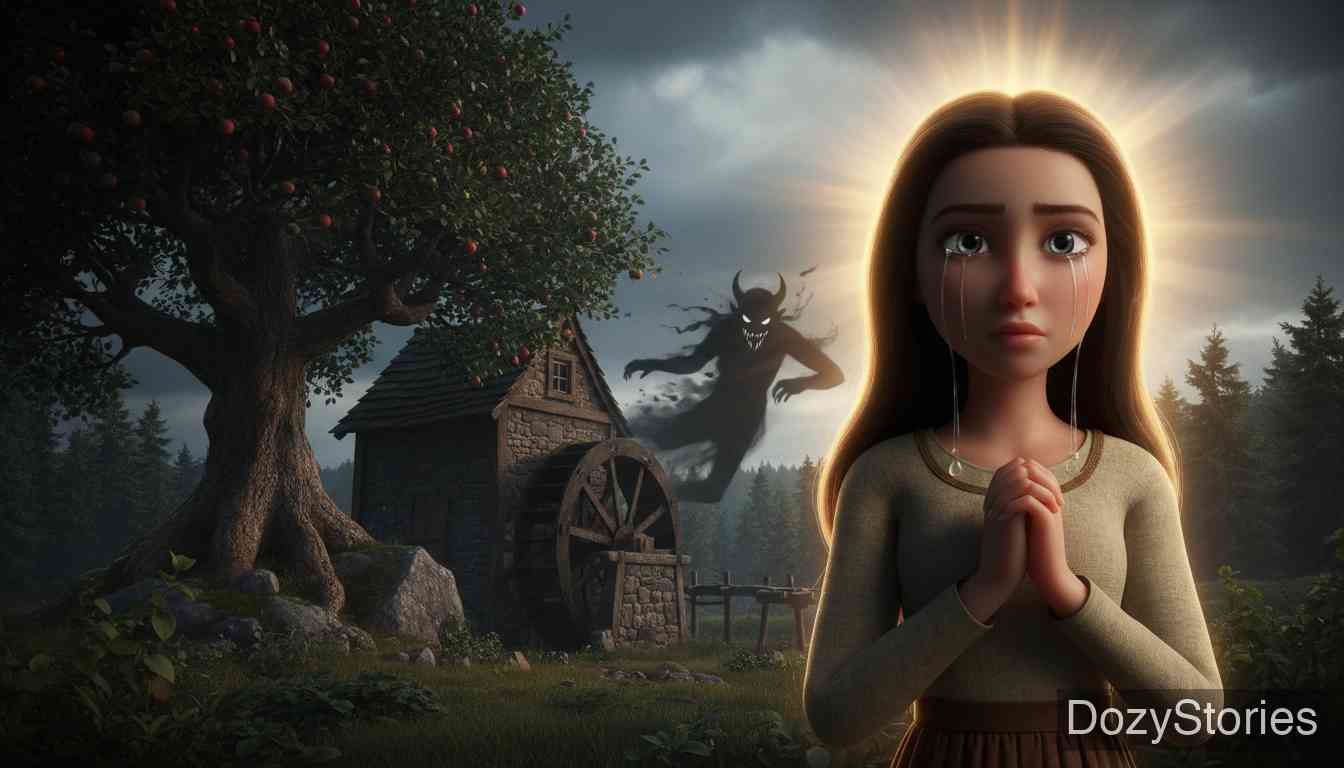
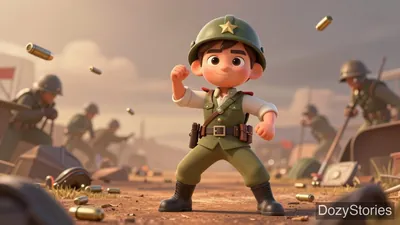
A certain miller had little by little fallen into poverty, and had nothing left but his mill and a large apple-tree behind it. Once when he had gone into the forest to fetch wood, an old man stepped up to him whom he had never seen before, and said, "Why dost thou plague thyself with cutting wood, I will make thee rich, if wilt promise me what is standing behind thy mill?" - "What can that be but my apple-tree?" thought the miller, and said, "Yes," and gave a written promise to the stranger. He, however, laughed mockingly and said, "When three years have passed, I will come and carry away what belongs to me," and then he went. When the miller got home, his wife came to meet him and said, "Tell me, miller, from whence comes this sudden wealth into our house? All at once every box and chest was filled; no one brought it in, and I know not how it happened." He answered, "It comes from a stranger who met me in the forest, and promised me great treasure. I, in return, have promised him what stands behind the mill; we can very well give him the big apple-tree for it." - "Ah, husband," said the terrified wife, "that must have been the devil! He did not mean the apple-tree, but our daughter, who was standing behind the mill sweeping the yard."
The miller's daughter was a beautiful, pious girl, and lived through the three years in the fear of God and without sin. When therefore the time was over, and the day came when the Evil-one was to fetch her, she washed herself clean, and made a circle round herself with chalk. The devil appeared quite early, but he could not come near to her. Angrily, he said to the miller, "Take all water away from her, that she may no longer be able to wash herself, for otherwise I have no power over her." The miller was afraid, and did so. The next morning the devil came again, but she had wept on her hands, and they were quite clean. Again he could not get near her, and furiously said to the miller, "Cut her hands off, or else I cannot get the better of her." The miller was shocked and answered, "How could I cut off my own child's hands?" Then the Evil-one threatened him and said, "If thou dost not do it thou art mine, and I will take thee thyself." The father became alarmed, and promised to obey him. So he went to the girl and said, "My child, if I do not cut off both thine hands, the devil will carry me away, and in my terror I have promised to do it. Help me in my need, and forgive me the harm I do thee." She replied, "Dear father, do with me what you will, I am your child." Thereupon she laid down both her hands, and let them be cut off. The devil came for the third time, but she had wept so long and so much on the stumps, that after all they were quite clean. Then he had to give in, and had lost all right over her.
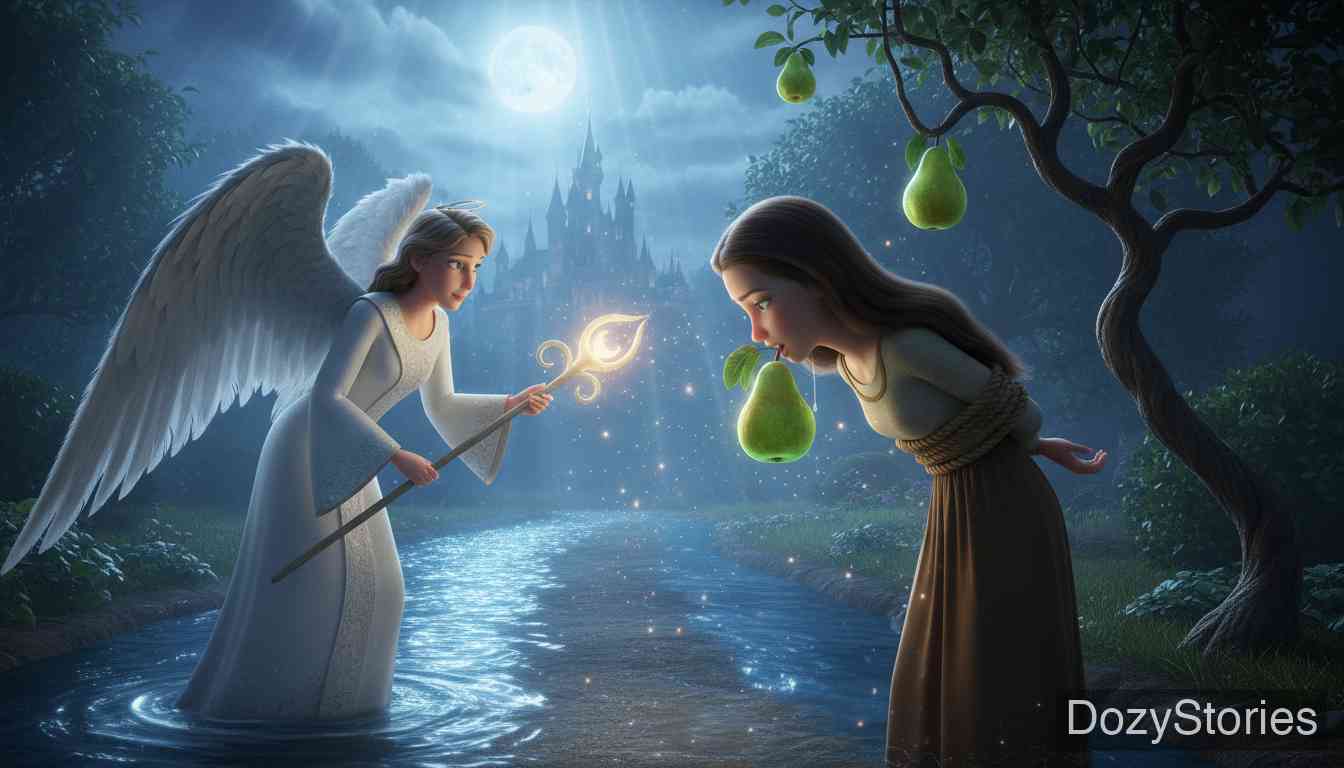
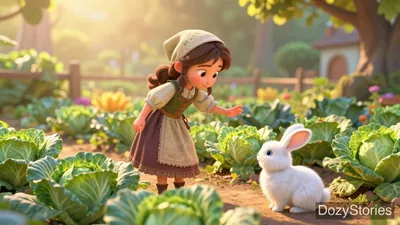
The miller said to her, "I have by means of thee received such great wealth that I will keep thee most delicately as long as thou livest." But she replied, "Here I cannot stay, I will go forth, compassionate people will give me as much as I require." Thereupon she caused her maimed arms to be bound to her back, and by sunrise she set out on her way, and walked the whole day until night fell. Then she came to a royal garden, and by the shimmering of the moon she saw that trees covered with beautiful fruits grew in it, but she could not enter, for there was much water round about it. And as she had walked the whole day and not eaten one mouthful, and hunger tormented her, she thought, "Ah, if I were but inside, that I might eat of the fruit, else must I die of hunger!" Then she knelt down, called on God the Lord, and prayed. And suddenly an angel came towards her, who made a dam in the water, so that the moat became dry and she could walk through it. And now she went into the garden and the angel went with her. She saw a tree covered with beautiful pears, but they were all counted. Then she went to them, and to still her hunger, ate one with her mouth from the tree, but no more. The gardener was watching; but as the angel was standing by, he was afraid and thought the maiden was a spirit, and was silent, neither did he dare to cry out, or to speak to the spirit. When she had eaten the pear, she was satisfied, and went and concealed herself among the bushes.
The King to whom the garden belonged, came down to it next morning, and counted, and saw that one of the pears was missing, and asked the gardener what had become of it, as it was not lying beneath the tree, but was gone. Then answered the gardener, "Last night, a spirit came in, who had no hands, and ate off one of the pears with its mouth." The King said, "How did the spirit get over the water, and where did it go after it had eaten the pear?" The gardener answered, "Some one came in a snow-white garment from heaven who made a dam, and kept back the water, that the spirit might walk through the moat. And as it must have been an angel, I was afraid, and asked no questions, and did not cry out. When the spirit had eaten the pear, it went back again." The King said, "If it be as thou sayest, I will watch with thee to-night."
When it grew dark the King came into the garden and brought a priest with him, who was to speak to the spirit. All three seated themselves beneath the tree and watched. At midnight the maiden came creeping out of the thicket, went to the tree, and again ate one pear off it with her mouth, and beside her stood the angel in white garments. Then the priest went out to them and said, "Comest thou from heaven or from earth? Art thou a spirit, or a human being?" She replied, "I am no spirit, but an unhappy mortal deserted by all but God." The King said, "If thou art forsaken by all the world, yet will I not forsake thee." He took her with him into his royal palace, and as she was so beautiful and good, he loved her with all his heart, had silver hands made for her, and took her to wife.
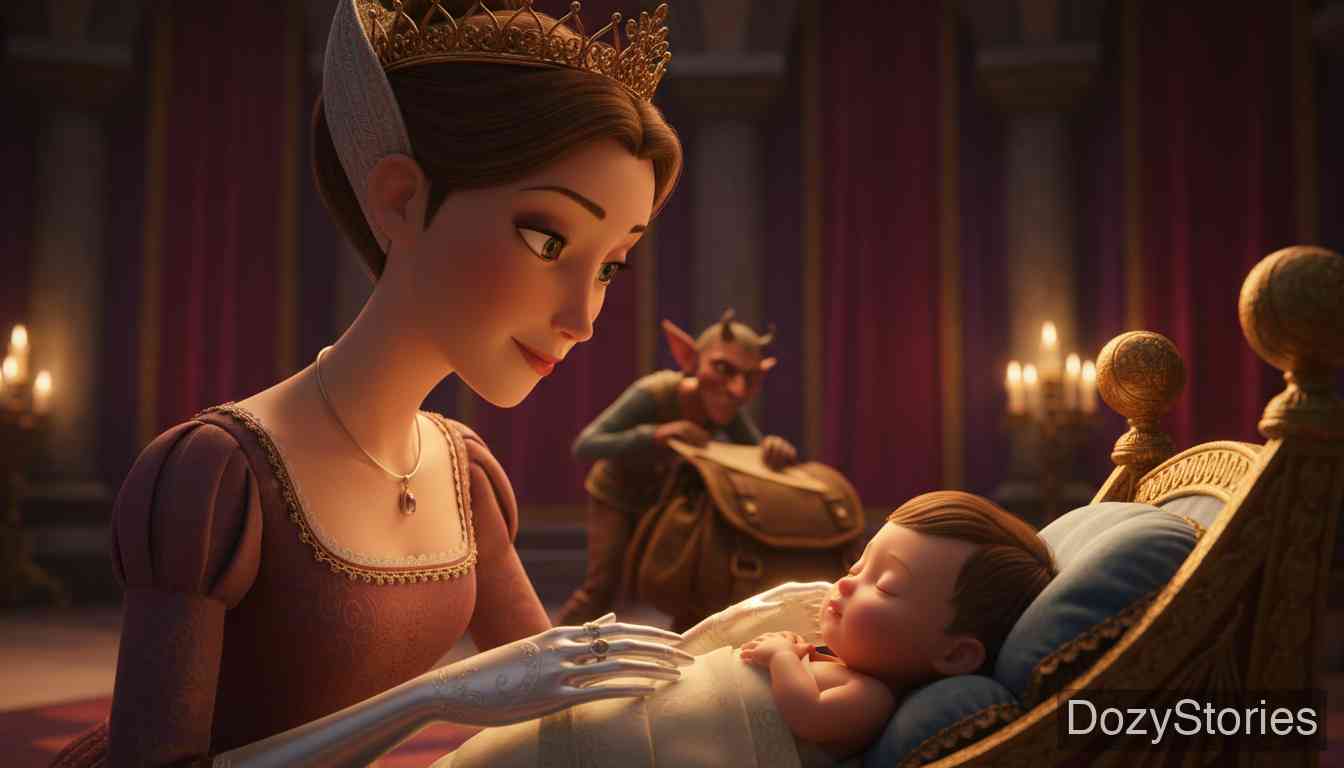
After a year the King had to take the field, so he commended his young Queen to the care of his mother and said, "If she is brought to bed take care of her, nurse her well, and tell me of it at once in a letter." Then she gave birth to a fine boy. So the old mother made haste to write and announce the joyful news to him. But the messenger rested by a brook on the way, and as he was fatigued by the great distance, he fell asleep. Then came the Devil, who was always seeking to injure the good Queen, and exchanged the letter for another, in which was written that the Queen had brought a monster into the world. When the King read the letter he was shocked and much troubled, but he wrote in answer that they were to take great care of the Queen and nurse her well until his arrival. The messenger went back with the letter, but rested at the same place and again fell asleep. Then came the Devil once more, and put a different letter in his pocket, in which it was written that they were to put the Queen and her child to death. The old mother was terribly shocked when she received the letter, and could not believe it. She wrote back again to the King, but received no other answer, because each time the Devil substituted a false letter, and in the last letter it was also written that she was to preserve the Queen's tongue and eyes as a token that she had obeyed.
But the old mother wept to think such innocent blood was to be shed, and had a hind brought by night and cut out her tongue and eyes, and kept them. Then said she to the Queen, "I cannot have thee killed as the King commands, but here thou mayst stay no longer. Go forth into the wide world with thy child, and never come here again." The poor woman tied her child on her back, and went away with eyes full of tears. She came into a great wild forest, and then she fell on her knees and prayed to God, and the angel of the Lord appeared to her and led her to a little house on which was a sign with the words, "Here all dwell free." A snow-white maiden came out of the little house and said, 'Welcome, Lady Queen," and conducted her inside. Then they unbound the little boy from her back, and held him to her breast that he might feed, and laid him in a beautifully-made little bed. Then said the poor woman, "From whence knowest thou that I was a queen?" The white maiden answered, "I am an angel sent by God, to watch over thee and thy child." The Queen stayed seven years in the little house, and was well cared for, and by God's grace, because of her piety, her hands which had been cut off, grew once more.
At last the King came home again from the war, and his first wish was to see his wife and the child. Then his aged mother began to weep and said, "Thou wicked man, why didst thou write to me that I was to take those two innocent lives?" and she showed him the two letters which the Evil-one had forged, and then continued, "I did as thou badest me," and she showed the tokens, the tongue and eyes. Then the King began to weep for his poor wife and his little son so much more bitterly than she was doing, that the aged mother had compassion on him and said, "Be at peace, she still lives; I secretly caused a hind to be killed, and took these tokens from it; but I bound the child to thy wife's back and bade her go forth into the wide world, and made her promise never to come back here again, because thou wert so angry with her." Then spoke the King, "I will go as far as the sky is blue, and will neither eat nor drink until I have found again my dear wife and my child, if in the meantime they have not been killed, or died of hunger."
Thereupon the King travelled about for seven long years, and sought her in every cleft of the rocks and in every cave, but he found her not, and thought she had died of want. During the whole of this time he neither ate nor drank, but God supported him. At length he came into a great forest, and found therein the little house whose sign was, "Here all dwell free." Then forth came the white maiden, took him by the hand, led him in, and said, "Welcome, Lord King," and asked him from whence he came. He answered, "Soon shall I have travelled about for the space of seven years, and I seek my wife and her child, but cannot find them." The angel offered him meat and drink, but he did not take anything, and only wished to rest a little. Then he lay down to sleep, and put a handkerchief over his face.
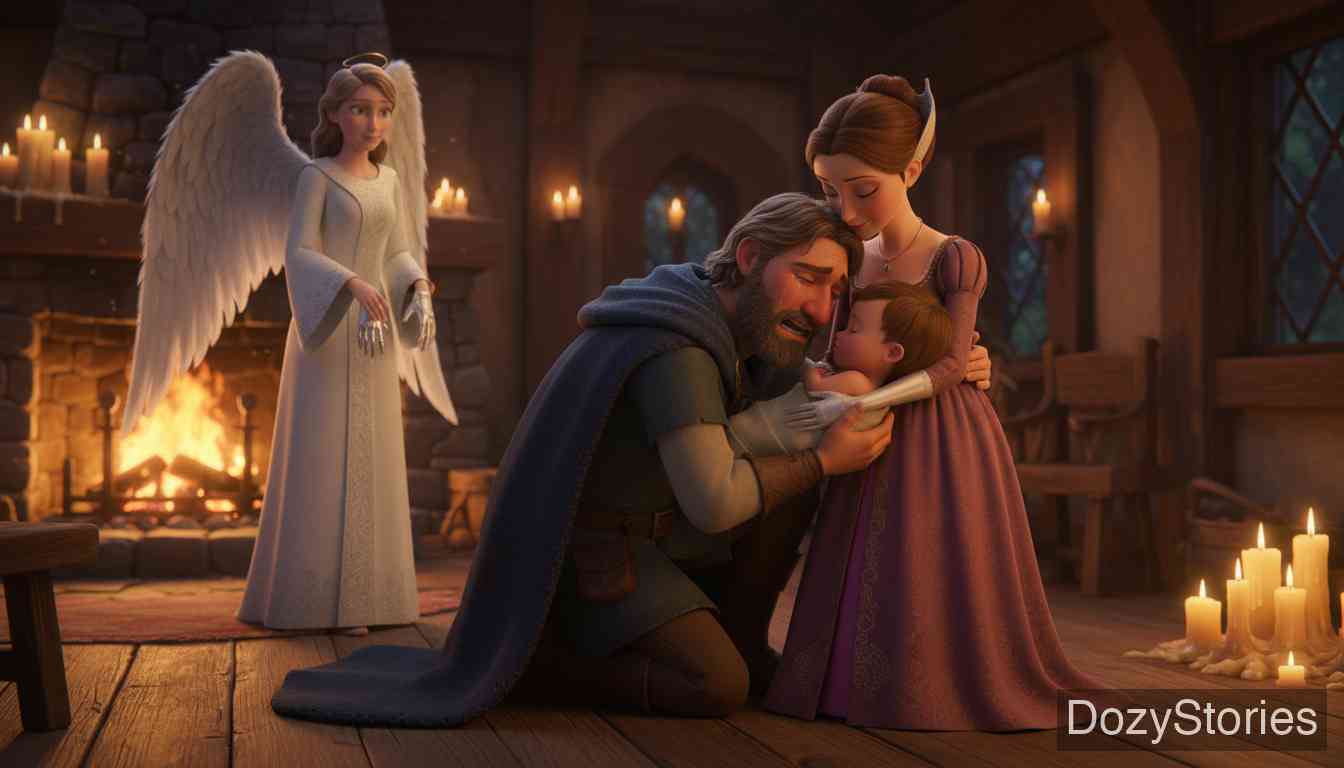
Thereupon the angel went into the chamber where the Queen sat with her son, whom she usually called "Sorrowful," and said to her, "Go out with thy child, thy husband hath come." So she went to the place where he lay, and the handkerchief fell from his face. Then said she, "Sorrowful, pick up thy father's handkerchief, and cover his face again." The child picked it up, and put it over his face again. The King in his sleep heard what passed, and had pleasure in letting the handkerchief fall once more. But the child grew impatient, and said, "Dear mother, how can I cover my father's face when I have no father in this world? I have learnt to say the prayer, 'Our Father, which art in Heaven,' thou hast told me that my father was in Heaven, and was the good God, and how can I know a wild man like this? He is not my father." When the King heard that, he got up, and asked who they were. Then said she, "I am thy wife, and that is thy son, Sorrowful." And he saw her living hands, and said, "My wife had silver hands." She answered, "The good God has caused my natural hands to grow again;" and the angel went into the inner room, and brought the silver hands, and showed them to him. Hereupon he knew for a certainty that it was his dear wife and his dear child, and he kissed them, and was glad, and said, "A heavy stone has fallen from off mine heart." Then the angel of God gave them one meal with her, and after that they went home to the King's aged mother. There were great rejoicings everywhere, and the King and Queen were married again, and lived contentedly to their happy end.

Vocabulary from "The Girl Without Hands"

12 key words from this story with definitions and original context sentences for language learners.

plagueB2
/pleɪɡ/v.

To cause continual trouble, worry, or hardship to someone.

使苦恼;折磨;不断困扰。

Why dost thou plague thyself with cutting wood, I will make thee rich.

你何必这么辛苦砍柴呢?我就让你发大财。

mockingly(mock)B2
/ˈmɒkɪŋli/adv.

In a way that makes fun of someone or something; scornfully.

嘲弄地;嘲笑地;轻蔑地。

He, however, laughed mockingly and said, "When three years have passed, I will come and carry away what belongs to me."

陌生人嘲笑着说:'三年后,我来取走属于我的东西。'

terrified(terrify)B1
/ˈterɪfaɪd/adj.

Extremely frightened; filled with terror.

极度惊恐的;吓坏了的。

"Ah, husband," said the terrified wife, "that must have been the devil!"

妻子惊恐地喊道:'那一定是魔鬼!'

maimed(maim)C1
/meɪmd/adj.

Seriously wounded so that part of the body is damaged or lost.

残废的;被弄致伤残的。

Thereupon she caused her maimed arms to be bound to her back.

于是她让人把残缺的断臂捆在背上。

compassionateB2
/kəmˈpæʃənət/adj.

Feeling or showing sympathy and concern for others.

有同情心的;富有怜悯之心的。

I will go forth, compassionate people will give me as much as I require.

我要去远方流浪,慈悲的人们会给我所需的。

moatB2
/məʊt/n.

A deep, wide ditch filled with water surrounding a castle or garden for defence.

护城河;(城堡或园林周围的)壕沟。

An angel came towards her, who made a dam in the water, so that the moat became dry.

一位天使出现了,天使在水中筑起一道坝,排干了护城河的水。

forsaken(forsake)C1
/fərˈseɪkən/v.

Abandoned or left completely alone (past participle of 'forsake').

(forsake 的过去分词)被抛弃的;被遗弃的。

If thou art forsaken by all the world, yet will I not forsake thee.

即便全世界都抛弃你,我也不会抛弃你。

commended(commend)C1
/kəˈmendɪd/v.

Entrusted someone or something to another's care.

把……托付给(某人照料)。

So he commended his young Queen to the care of his mother.

将年轻的王后托付给母亲照顾。

fatigued(fatigue)B2
/fəˈtiːɡd/adj.

Very tired; exhausted.

疲惫的;筋疲力尽的。

As he was fatigued by the great distance, he fell asleep.

送信人因路途遥远而疲惫,在半路睡着了。

substituted(substitute)B2
/ˈsʌbstɪtjuːtɪd/v.

Put one thing in place of another; swapped.

用……替换;把……调换。

Each time the Devil substituted a false letter.

每次信件都被魔鬼调包。

hindC1
/haɪnd/n.

A female deer, especially a red deer.

母鹿;雌鹿(尤指赤鹿)。

The old mother had a hind brought by night and cut out her tongue and eyes.

老王后趁夜杀了一头野鹿,取下舌头和眼睛。

pietyC1
/ˈpaɪəti/n.

Deep respect for God and religion; devout behaviour.

虔诚;对宗教的笃信与敬畏。

By God's grace, because of her piety, her hands which had been cut off, grew once more.

因其虔诚,蒙受上帝恩赐,她被砍断的双手竟然重新长出。

Reading Together & Learning More

The Moral

Goodness and endurance are never wasted, even in the deepest suffering; however hopeless things seem, keeping an upright heart will in the end bring a turn for the better.

Educational Value

Helps children appreciate the power of resilience, forgiveness, and hope, while the miller's rash promise teaches them to understand exactly what they are agreeing to before they make a promise.

Tips for Parents

This is a longer, heavily religious and emotionally heavy Grimm tale (it includes hands being cut off and forged death warrants), best read with older children over more than one sitting. Discuss with your child: why did the miller fall into the devil's trap, and what can we do when we are wrongly accused?

Talk About It

  1. When the miller promises the stranger 'what stands behind the mill,' he thinks it is only an apple tree. What should we make sure of before we promise something?
  2. Faced with the devil's threat, the father cuts off his daughter's hands. Do you think he had another choice? What would you have done?
  3. The girl loses her hands, is driven from home, and is framed by forged letters, yet she never becomes cold or bitter. What do you think kept her going?
  4. The old mother refuses to carry out the order to kill the Queen and her child, and saves them instead. Was she right to risk disobeying what she thought was 'the King's command'?
  5. Almost all the trouble in the story is caused by the devil swapping letters. Why is it important to check whether 'bad news' is really true before we believe it?