Hansel and Grethel

Introduction

Hansel and Grethel is one of the best-loved of all the Grimm tales, and its house of bread and sugar has become an image almost every child knows. Yet it is more than a sweet adventure. Many scholars connect the story to the great famines of medieval Europe: in years when food ran out, the cruel idea of leaving children in the forest echoes a genuinely desperate history. As in Snow White, the early Grimm editions made the mother — not a stepmother — the one who abandons the children; the brothers changed her later. The closing line, 'My tale is done, there runs a mouse…,' is a traditional folk formula the storyteller used to wink at the audience and break the spell. As you read, you might ask your child why the most tempting house turns out to be the most dangerous place of all.

Font Size
1 / 29
Stopped
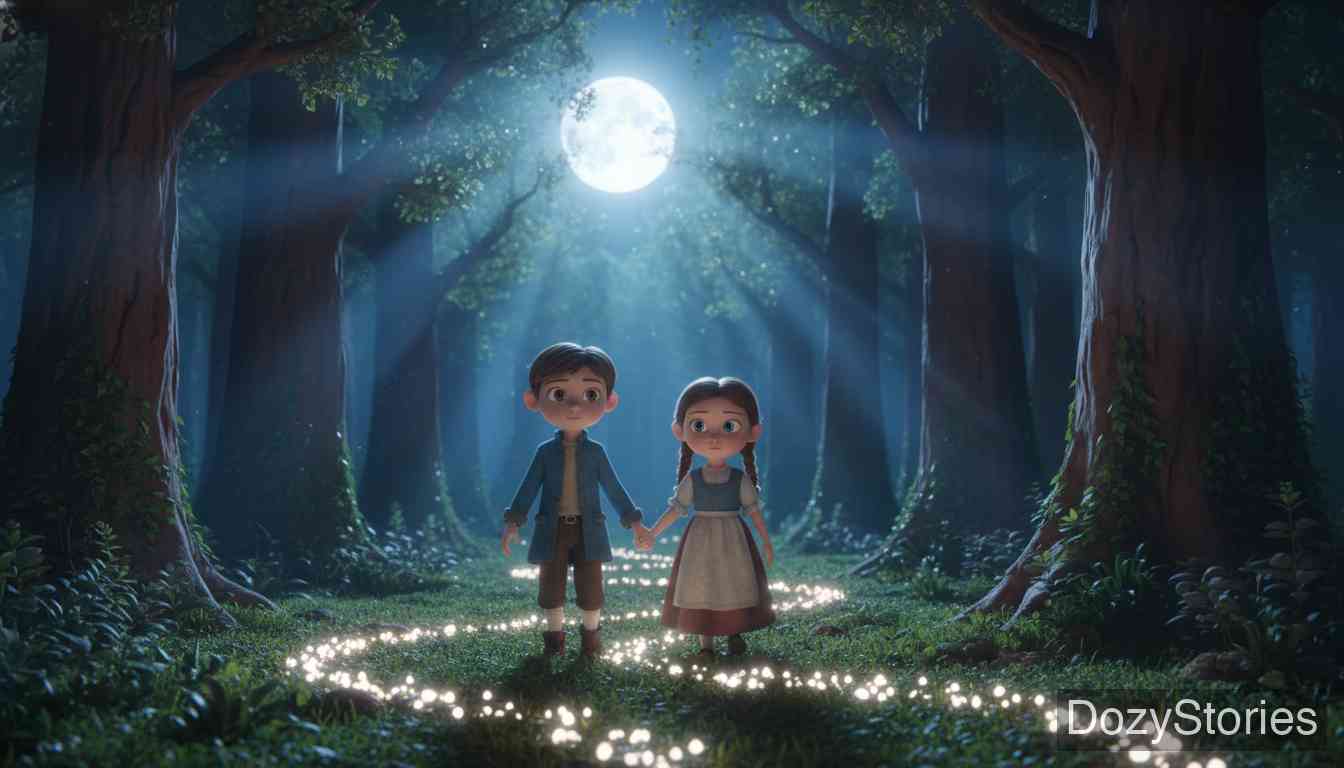
Hansel and Grethel - At the edge of a moonlit forest, clever Hansel uses glistening flint stones to mark the path home during the first abandonment. - Scene Illustration 1
At the edge of a moonlit forest, clever Hansel uses glistening flint stones to mark the path home during the first abandonment.
At the edge of a great forest there lived a poor woodcutter with his wife and his two children. The boy was called Hansel and the girl Grethel. They never had much to eat, and when a famine spread across the land, the man could no longer earn even their daily bread. One night he lay awake turning the problem over, and at last he sighed and said to his wife, "What is to become of us? We cannot feed the children, and there is nothing left for ourselves."
"Listen to me, husband," his wife answered. "Tomorrow at first light we will take the children into the thickest part of the forest. We will build them a fire and give each of them a piece of bread. Then we will go off to our work and leave them there. They will never find their way home, and we shall be rid of them."
"No, wife," said the man. "I could not bring myself to do it. How could I leave my own children alone in the forest? The wild animals would find them before long and tear them to pieces." "You fool," she said. "Then all four of us will starve. You may as well start planing the boards for our coffins." She gave him no peace until he agreed. "All the same, I am sorry for the poor children," the man said.
The two children had been too hungry to sleep, and they had heard every word their stepmother said. Grethel wept bitterly. "Now it is all over with us," she whispered to Hansel.
"Hush, Grethel," said Hansel. "Do not worry. I will think of something." When his parents were asleep he got up, pulled on his little coat, opened the back door, and slipped outside. The moon was shining, and the white pebbles in front of the house glittered like silver coins. Hansel crouched down and stuffed his coat pockets with as many as they would hold. Then he went back in. "Rest easy, little sister, and go to sleep," he said. "We will not be left to ourselves." And he lay down again in his own bed.
Before sunrise the woman came and shook the two children awake. "Get up, you lazybones. We are going into the forest to cut wood." She gave each of them a piece of bread. "That is your dinner. Do not eat it before noon, because you will get nothing more." Grethel carried both pieces under her apron, since Hansel's pockets were full of pebbles. Then they all set out together. After a little way Hansel stopped and looked back at the house, and he did it again, and then again, until his father called out, "Hansel, what are you staring at? Mind where you put your feet."
"Oh, Father, I am watching my little white kitten. She is sitting up on the roof to say goodbye to me." "You silly boy," said the woman, "that is no kitten. It is the morning sun on the chimney." Of course Hansel had not been looking at any kitten. Each time he turned, he had dropped another white pebble on the path behind him. When they reached the middle of the forest, the father told the children to gather wood for a fire to keep them warm. Hansel and Grethel collected a whole mountain of brushwood, and it was lit, and when the flames were burning high the woman said, "Lie down by the fire and rest, children. We are going to cut wood, and we will fetch you when we have finished."
So Hansel and Grethel sat by the fire, and at noon they ate their bread. They believed their father was working nearby, because they kept hearing the blows of an axe. In fact it was only a dead branch that he had tied to a withered tree, knocking back and forth in the wind. They waited a long while, and their eyes grew heavy, and they fell fast asleep. When they woke it was night. Grethel began to cry. "How will we ever get out of this forest?" But Hansel comforted her. "Wait until the moon is up," he said, "and then we will find the way easily enough." When the full moon rose he took his sister's hand and followed the pebbles, which shone like silver and marked the road for them. They walked all night, and at daybreak they reached their father's house. They knocked, and when the woman opened the door and saw who it was she said, "You wicked children, why did you sleep so long in the forest? We thought you were never coming back." But the father was glad, for it had cut him to the heart to leave them there.
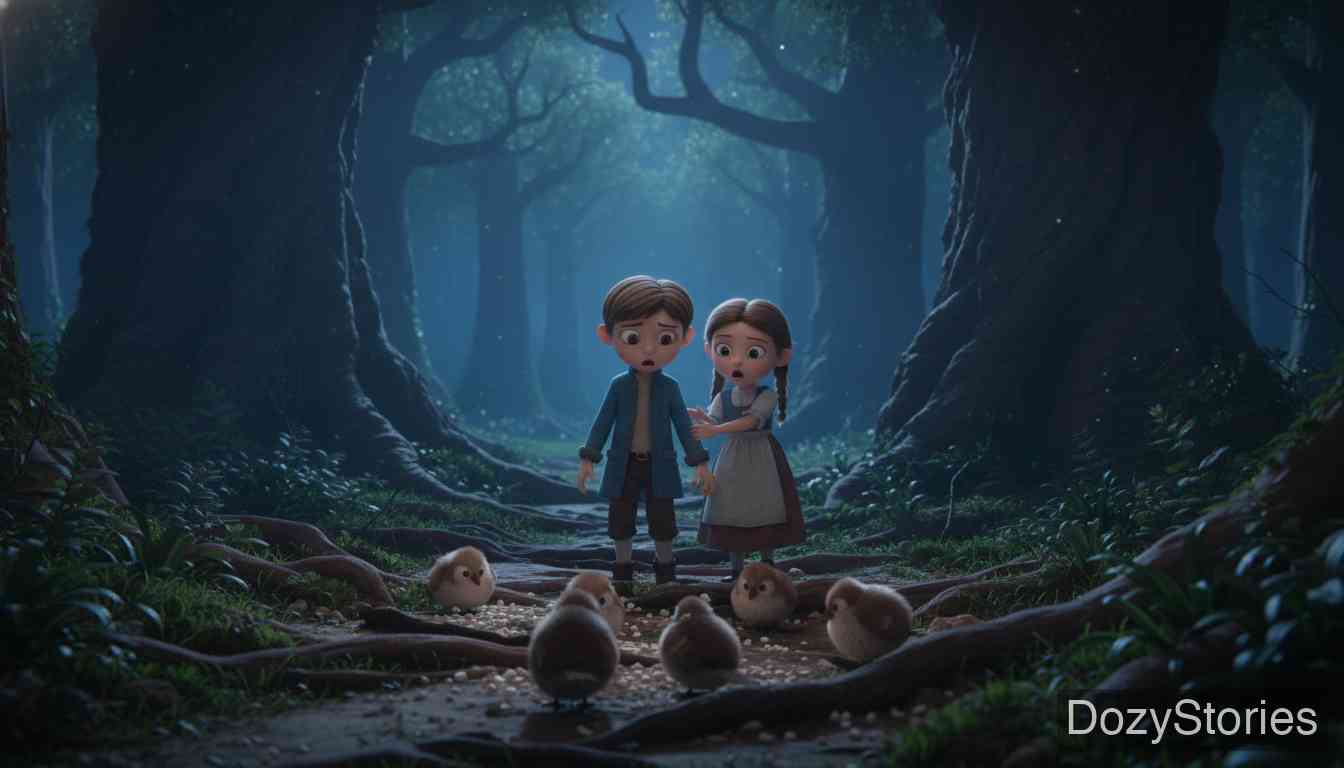
Hansel and Grethel - Despair returns as Hansel is forced to mark the path with breadcrumbs, but the birds devour the trail, leaving the children lost in the deep woods. - Scene Illustration 2
Despair returns as Hansel is forced to mark the path with breadcrumbs, but the birds devour the trail, leaving the children lost in the deep woods.
Not long afterwards there was hunger in the land again, and one night the children heard their mother speaking to their father in bed. "Everything is eaten up. We have half a loaf left, and after that we are finished. The children must go. This time we will take them deeper into the forest, so they cannot find their way back. There is nothing else to be done." The man's heart was heavy. Better to share your last mouthful with your children, he thought. But his wife would not listen to a word of it, and she scolded and blamed him until he gave way. A man who has said yes once finds it harder to say no the second time.
The children were still awake and had heard it all. When the parents were asleep, Hansel got up to collect pebbles again, but the woman had locked the door and he could not get out. He comforted his sister all the same. "Do not cry, Grethel. Go to sleep. Help will come." Early the next morning the woman pulled them both out of bed and handed them each a piece of bread, smaller than the last. On the way into the forest, Hansel crumbled his in his pocket and kept stopping to drop a few crumbs on the ground. "Hansel, why do you keep falling behind and staring about?" said his father.
"I am looking at my little pigeon on the roof. He is saying goodbye to me," Hansel answered. "You fool," said the woman, "that is no pigeon. It is the morning sun on the chimney." Hansel went on as before and dropped his crumbs the whole way. The woman led the children deep into the forest, into a part they had never seen in their lives. Again a great fire was built, and the mother said, "Sit here, children, and sleep if you are tired. We are going in to cut wood, and this evening, when we are done, we will come for you."
At noon Grethel shared her bread with Hansel, who had scattered his along the road. Then they slept, and the evening came and went, and nobody fetched the poor children. When they woke it was pitch dark. Hansel comforted his sister again. "Wait a little, Grethel, until the moon is up. Then we will see the crumbs I dropped, and they will lead us home."
But when the moon rose and they went to look, there was not a crumb left. The birds of the woods and fields had eaten every one. Hansel still believed they could find the way, but they could not. They walked all that night, and all the next day from morning until evening, and they never came out of the forest. They were terribly hungry, with nothing to eat but a few berries. At last they were too tired to drag themselves any further, and they lay down under a tree and fell asleep.
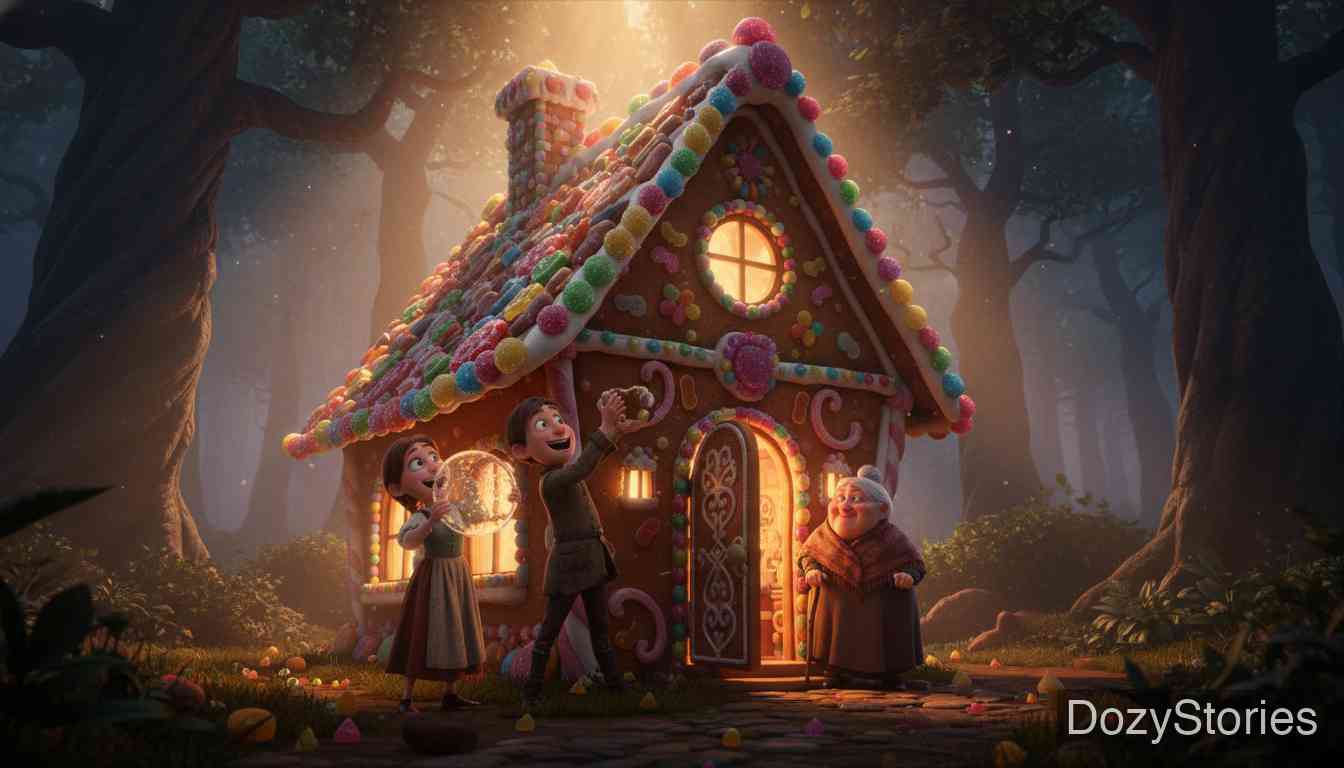
Hansel and Grethel - Driven by hunger, the children discover a marvelous house made of bread, cakes, and sugar, unaware that this sweet temptation is a trap set by a wicked witch. - Scene Illustration 3
Driven by hunger, the children discover a marvelous house made of bread, cakes, and sugar, unaware that this sweet temptation is a trap set by a wicked witch.
It was the third morning since they had left their father's house. They kept trying to walk back towards it, but every hour took them further in, and if help had not come soon they would have starved.
About noon they saw a snow-white bird on a branch, singing so sweetly that they stopped to listen. When the song was finished, the bird spread its wings and flew ahead of them, and they followed it until they came to a little house. The bird settled on the roof. As they came closer, the children saw that the walls of the house were made of bread and the roof of cake, and the windows were clear sugar. "Let us help ourselves," said Hansel, "and have a proper meal. I will take a piece of the roof, Grethel, and you can try the window. That will be sweet." So Hansel reached up and broke off a piece of the roof to taste it, and Grethel stood at the window and nibbled. Then a thin voice called from inside: "Munch and crunch, a nibbling mouse, who is eating at my house?" And the children called back: "Only the breeze, among the trees."
They went on eating without the least worry. Hansel decided the roof tasted excellent and pulled down a large slab of it, and Grethel worked a whole round pane out of the window, sat down, and began on it.
Then the door opened, and a very old woman came out on a crutch. Hansel and Grethel were so frightened that they dropped what they were holding. But the old woman only nodded at them. "Dear children, how did you come here? Come inside and stay with me. You will be no trouble at all." She took them each by the hand and led them into her little house. A fine meal was waiting there: milk and pancakes with sugar, and apples and nuts. Afterwards she showed them two small white beds, and Hansel and Grethel lay down in them and felt they were in heaven.
But the old woman was only pretending to be kind. She was a wicked witch who lay in wait for children, and she had built the house of bread on purpose to lure them in. Once a child was inside, she would kill it, cook it, and eat it, and that was a feast day for her.
The witch had red eyes and could not see far, but her sense of smell was as keen as an animal's, and she always knew when a human came near. As soon as she knew Hansel and Grethel were close, she laughed a spiteful laugh. "I have them now," she said, "and they will not get away from me."
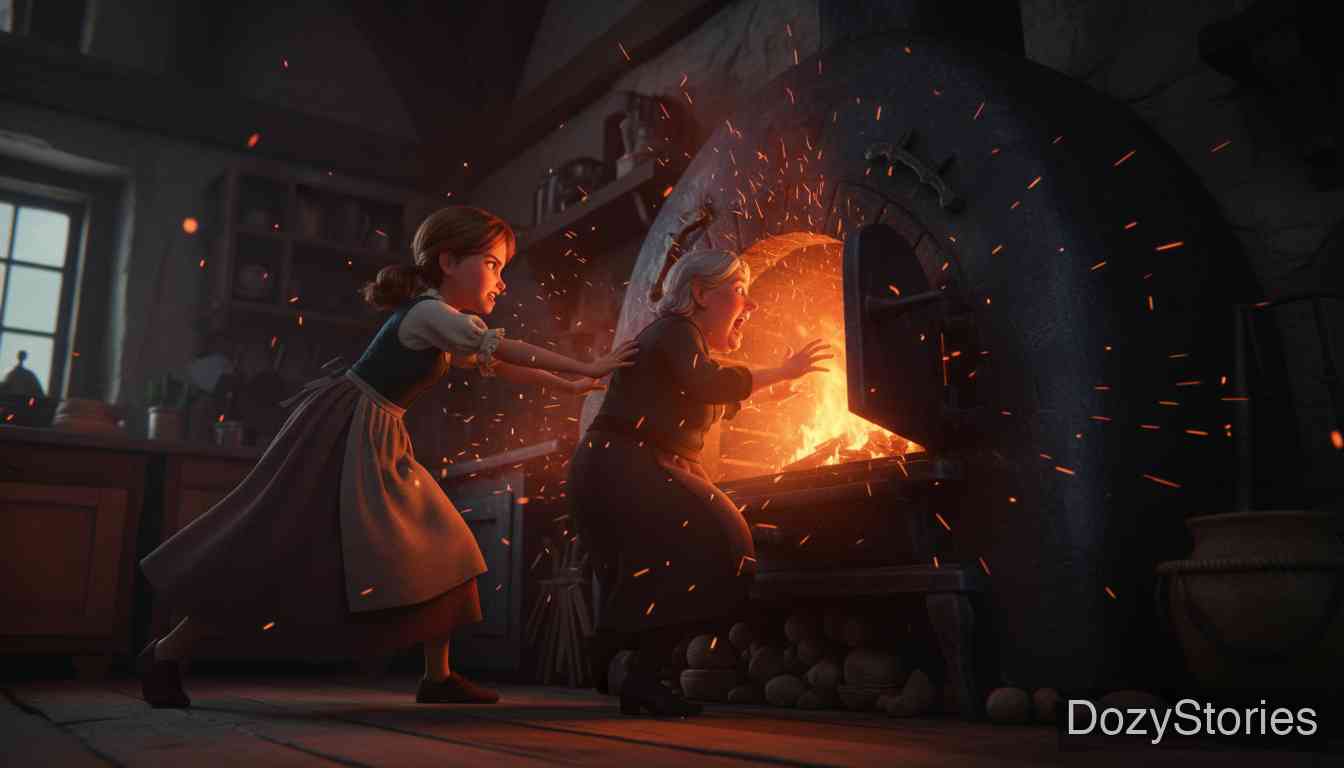
Hansel and Grethel - Hansel is caged to be fattened, while Grethel, in a moment of desperate courage, tricks the witch into checking the oven and pushes her into the flames. - Scene Illustration 4
Hansel is caged to be fattened, while Grethel, in a moment of desperate courage, tricks the witch into checking the oven and pushes her into the flames.
Early in the morning, before the children woke, she got up to look at them. They lay sleeping so peacefully, with round rosy cheeks, that she said to herself, "What a fine meal that will make." Then she seized Hansel with her bony hand, carried him out to a little stable, and shut him in behind a grating. He shouted and screamed, but it did him no good.
Then she went back and shook Grethel awake. "Get up, lazybones. Fetch water and cook something good for your brother. He is out in the stable and he must be fattened up. When he is fat enough, I will eat him." Grethel wept bitterly, but it made no difference. She had to do exactly what the wicked witch told her. So the finest food was cooked for poor Hansel, while Grethel was given nothing but crab shells.
Every morning the old woman went out to the little stable and called, "Hansel, stick out your finger, so I can feel whether you are fat enough yet." But Hansel always held out a thin bone instead, and the old woman's eyes were too weak to tell the difference. She took it for his finger and could not understand why he never grew any plumper.
When four weeks had gone by and Hansel was still as thin as ever, she ran out of patience. "Grethel!" she shouted. "Be quick and fetch the water. Fat or thin, tomorrow I will kill him and cook him." How the poor little sister grieved as she carried the water, and how the tears ran down her face. "Dear God, please help us," she cried. "If the wild animals had eaten us in the forest, at least we should have died together."
"Save your weeping," said the old woman. "It will not help you." Early the next morning Grethel had to get up, light the fire, and hang the kettle. "We will do the baking first," said the witch. "I have heated the oven and kneaded the dough already." She pushed Grethel towards the oven, where the flames were already leaping.
"Creep inside," said the witch, "and tell me whether it is hot enough for the bread." Once Grethel was in, she meant to slam the door and bake her and eat her. But Grethel saw what she was planning. "I do not know how," she said. "How am I supposed to get in?" "Stupid goose," said the old woman, "the opening is wide enough. Look, I could climb in myself." And she bent down and pushed her head into the mouth of the oven. Then Grethel gave her a shove that sent her right inside, slammed the iron door, and dropped the bar across it. How horribly she howled, but Grethel ran off, and the wicked witch was left to burn.
Hansel and Grethel - Joy of freedom! Carrying the witch's treasures, the siblings cross the great water with the help of a white duck and return to their father, living happily ever after. - Scene Illustration 5
Joy of freedom! Carrying the witch's treasures, the siblings cross the great water with the help of a white duck and return to their father, living happily ever after.
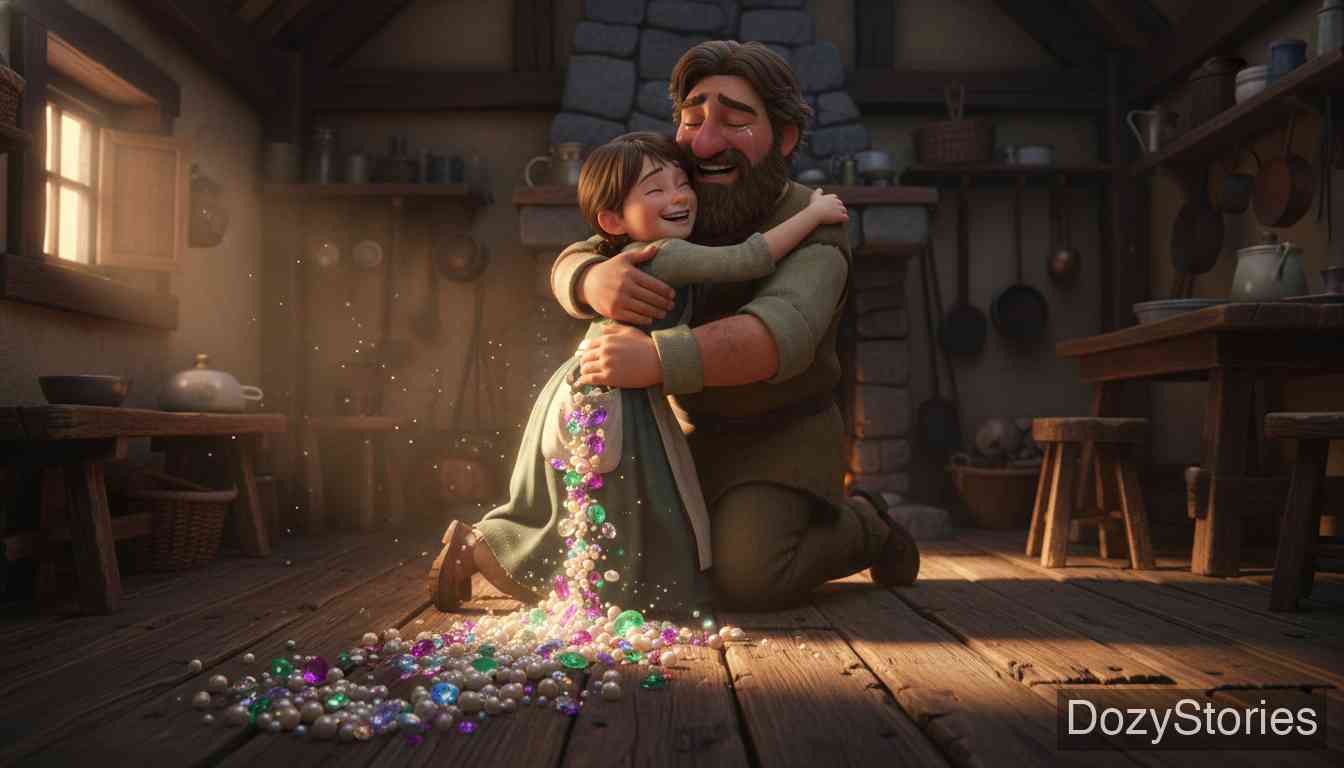
Grethel ran to the stable, pulled the door wide, and shouted, "Come out, Hansel! The old witch is dead and we are free!" Out he sprang like a bird when its cage is opened. How glad they were! They threw their arms round each other's necks, and danced, and kissed. And now that they had nothing left to fear, they went through the whole house, and in every corner there were chests of pearls and precious stones. "These are better than pebbles," said Hansel, filling his pockets, and Grethel wanted to carry something home too, so she filled her apron. "Now let us go," said Hansel, "if we can only get out of this witch's forest."
After a few hours' walking they came to a wide stretch of water. "We shall never get across," said Hansel. "There are no stepping stones and there is no bridge." "And there is no boat," said Grethel, "but here comes a white duck. If I ask her, she will carry us over." So she called: "White duck, white duck, hear us call, Hansel and Grethel, that is all. No bridge, no stone to help us through, carry us over, we trust you."
The duck came, and Hansel climbed onto her back and told his sister to get on as well. "No," said Grethel, "that would be too heavy for her. She can take us one at a time." And that is how they crossed.
After that they walked on happily. The forest grew more and more familiar, until at last they saw their father's house in the distance. They ran the rest of the way, burst in through the door, and threw their arms around their father's neck. The man had not known one peaceful hour since he left his children in the forest, and his wife was dead. Grethel shook out her apron, and the pearls and precious stones went bouncing all over the room, and Hansel pulled out one handful after another from his pockets. From then on their troubles were over, and they lived together in great happiness. My tale is finished. Look, there runs a mouse, and whoever catches it may make himself a fine fur cap out of it.

Vocabulary from "Hansel and Grethel"

12 key words from this story with definitions and original context sentences for language learners.

famineB2
/ˈfæmɪn/n.

A time when there is not enough food and many people go hungry.

饥荒。

They never had much to eat, and when a famine spread across the land, the man could no longer earn even their daily bread.

他们家从来没有多少吃的,等到饥荒蔓延全国,男人连一天的面包钱都挣不出来了。

glittered(glitter)B2
/ˈɡlɪtəd/v.

Shone with many small flashes of bright light.

闪闪发光;闪烁。

The moon was shining, and the white pebbles in front of the house glittered like silver coins.

月光很亮,屋前那些白石子闪得像银币一样。

withered(wither)B2
/ˈwɪðəd/adj.

Dried up and no longer living or fresh.

枯萎的;干枯的。

In fact it was only a dead branch that he had tied to a withered tree, knocking back and forth in the wind.

其实那只是一根他系在枯树上的死枝子,在风里来回敲打。

brushwoodC1
/ˈbrʌʃwʊd/n.

Small broken branches and twigs gathered for burning.

枯枝;柴火。

Hansel and Grethel collected a whole mountain of brushwood, and it was lit, and when the flames were burning high the woman said, "Lie down by the fire and rest, children."

韩赛尔和格蕾特拾回小山一样高的干柴,火点着了,等火苗蹿得老高,那女人说:"躺到火边歇着吧,孩子们。"

crumbled(crumble)B2
/ˈkrʌmbld/v.

Broke something soft into very small pieces.

捏碎;弄成碎屑。

On the way into the forest, Hansel crumbled his in his pocket and kept stopping to drop a few crumbs on the ground.

往林子里走的路上,韩赛尔在口袋里把面包捏碎,不时停下来往地上撒几粒屑。

lureB2
/lʊə/v.

To attract someone into a trap by offering something nice.

引诱;诱骗。

She was a wicked witch who lay in wait for children, and she had built the house of bread on purpose to lure them in.

她是个专门守候孩子的恶毒女巫,那座面包房子就是她特意盖来引诱孩子的。

spitefulB2
/ˈspaɪtfl/adj.

Wanting to hurt or upset someone on purpose.

恶毒的;存心伤人的。

As soon as she knew Hansel and Grethel were close, she laughed a spiteful laugh.

一发觉韩赛尔和格蕾特快到了,她就发出一声恶毒的笑。

seized(seize)B2
/siːzd/v.

Took hold of something suddenly and firmly.

一把抓住;攫住。

Then she seized Hansel with her bony hand, carried him out to a little stable, and shut him in behind a grating.

接着她用干瘦的手一把抓住韩赛尔,把他拎到一间小棚屋里,关在铁栅栏后面。

plumper(plump)B2
/ˈplʌmpə/adj.

Rounder and fatter than before, in a healthy way.

更胖一些的;更丰满的。

She took it for his finger and could not understand why he never grew any plumper.

她只当那是他的手指,怎么也想不通他为什么一点都不见胖。

patienceB1
/ˈpeɪʃns/n.

The ability to wait calmly without getting angry.

耐心。

When four weeks had gone by and Hansel was still as thin as ever, she ran out of patience.

四个星期过去,韩赛尔还是那么瘦,她再也没有耐心了。

kneaded(knead)C1
/ˈniːdɪd/v.

Pressed and folded dough with the hands to get it ready for baking.

揉(面)。

I have heated the oven and kneaded the dough already.

炉子我已经烧热了,面也揉好了。

preciousB1
/ˈpreʃəs/adj.

Rare and worth a great deal of money.

珍贵的;宝贵的。

And now that they had nothing left to fear, they went through the whole house, and in every corner there were chests of pearls and precious stones.

既然再没什么可怕的了,他们就把整座屋子走了一遍,每个角落里都堆着装满珍珠和宝石的箱子。

Reading Together & Learning More

The Moral

Wisdom and courage can help people overcome difficulties, and the mutual support between siblings is most precious.

Educational Value

Cultivates children's independent thinking, problem-solving skills, and courage when facing difficulties.

Tips for Parents

Discuss with your child: How did Hansel find solutions? Why is sibling unity important? How to recognize danger?

Talk About It

  1. Hansel marked the path with flint stones the first time and with breadcrumbs the second. Why did the stones work but the crumbs fail?
  2. The candy house looked so inviting but turned out to be a trap. What other things in life 'look wonderful but can be dangerous'?
  3. It was Grethel who found a way to push the witch into the oven. How do you think someone can stay calm like her when they are afraid?
  4. If you were lost together with a brother or sister, how would you work together and help each other?