Ferdinand the Faithful

Introduction

This tale, 'Ferdinand the Faithful,' is an old Grimm story at heart, but its spine is a lesson every culture knows: good deeds come back to those who do them. In Chinese we say, 'Do not refuse to do good simply because it is small.' Ferdinand picks up a pen no one wants and saves a fish nobody asked him to save — small, easy kindnesses that later turn out to be matters of life and death. The same motif runs through Chinese tales like 'The White Snake' and the story of the snail girl: help a creature, and the creature will help you. That is why this story suits the fable form so well. A fable is short, plain, and pointed: characters are good or bad in one sentence, and the two Ferdinands — Faithful and Unfaithful — stand side by side so children can see the difference at a glance. When you read together, let your child notice the two names and ask what one word changes; then look for small kindnesses in daily life that might later pay off in unexpected ways. One gentle warning: this tale keeps some rough edges from its days of being told aloud — a king with no nose, a queen who chops off heads and puts them back. Old stories do not always make tidy sense, and that is part of their charm. Do not rush to explain it all; let the tale work its quiet magic.

Font Size
1 / 26
Stopped
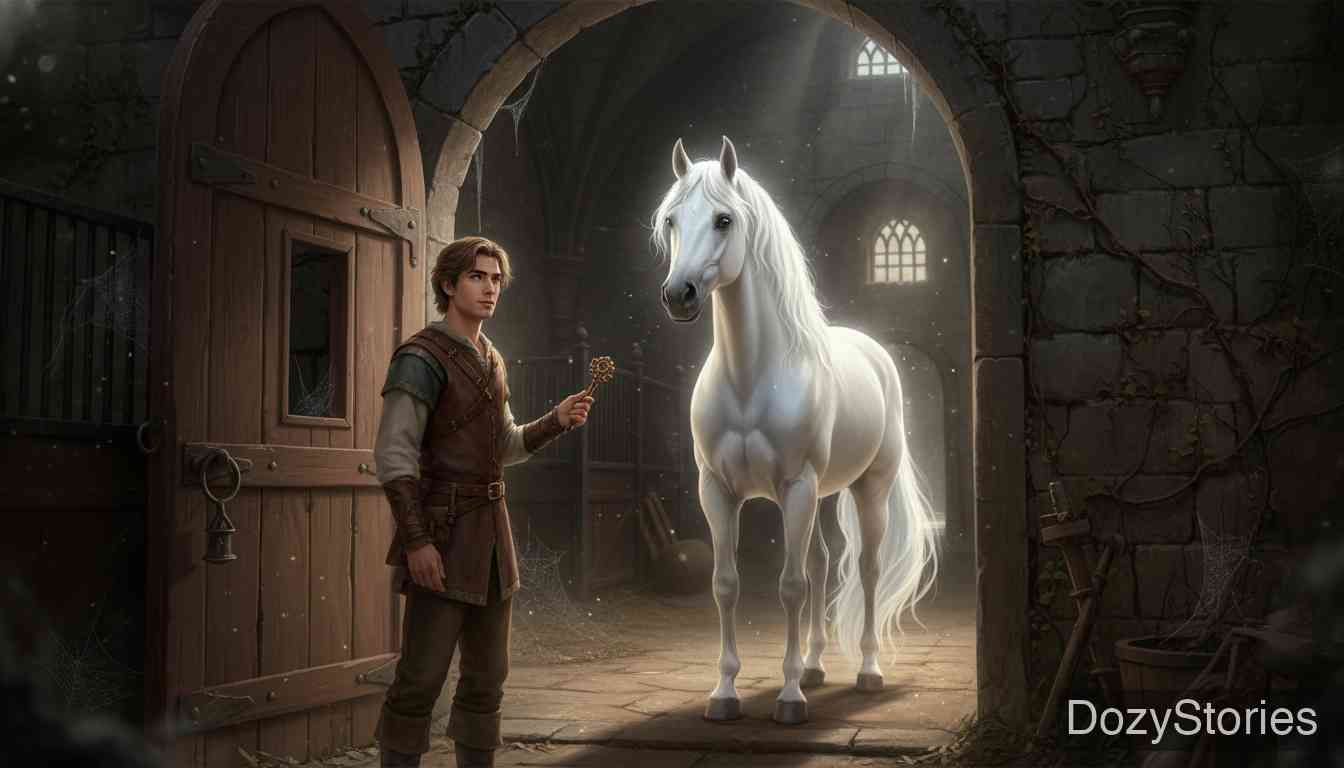
Ferdinand the Faithful - A poor family gains a beggar godfather and a magic key. Years later, grown-up Ferdinand opens a castle on the heath and finds a wonderful white horse. - Scene Illustration 1
A poor family gains a beggar godfather and a magic key. Years later, grown-up Ferdinand opens a castle on the heath and finds a wonderful white horse.
Long ago there lived a poor man and his wife. While they were rich, they had no child. When they became poor, a little son was born to them. They looked for a godfather for the boy, but no one would take the job, because the family had nothing to give.
So the father set out to search. On the road he met a beggar. 'Where are you going?' asked the beggar. 'I am looking for a godfather,' said the man. 'Everyone refuses, because we are poor.' The beggar smiled. 'You are poor, and so am I. I will be your boy's godfather. Bring him to the church.'
The beggar was waiting at the church. He gave the boy a name: Ferdinand the Faithful. When they left, he handed a small key to the nurse. 'Keep this key safe,' he said. 'When the boy turns fourteen, let him go to the heath. A castle stands there, and this key will open it. Everything inside will be his.'
Years passed, and the boy grew tall. At seven, he played with other children. Each one boasted about the gifts his godfather had given him. Ferdinand had nothing to say, and his heart felt heavy. He ran home and asked, 'Father, did my godfather give me nothing at all?' 'He gave you a key,' said his father. 'Go to the heath and see for yourself.'
The boy went to the heath, but he saw no castle. Seven more years passed. On the day he turned fourteen, he went there again. There stood a great castle. He opened the door with his key, and inside he found a single horse — a fine white horse.
Ferdinand was overjoyed. He jumped onto the horse and rode home. 'Father, I have a white horse!' he cried. 'Now I will ride out into the world and seek my fortune.'
Ferdinand the Faithful - He picks up a pen, saves a fish, and gains a flute. Then he meets Ferdinand the Unfaithful, and the two enter the king's service together. - Scene Illustration 2
He picks up a pen, saves a fish, and gains a flute. Then he meets Ferdinand the Unfaithful, and the two enter the king's service together.
He set out on his way. On the road he saw a pen lying in the dust. 'I will leave it there,' he thought. 'I can always find a pen where I am going.' But a voice called from behind: 'Ferdinand the Faithful, take the pen with you.' He turned around and saw no one. So he went back and picked it up.
A little later he came to a lake. A fish lay on the bank, gasping for breath. 'Wait, my dear fish,' said Ferdinand. 'I will put you back into the water.' He took the fish gently and tossed it into the lake.
The fish raised its head above the water. 'You saved me from the mud,' it said. 'Take this flute. Whenever you are in trouble, play it, and I will come to help you. If you drop anything into the water, play, and I will bring it back to you.'
Ferdinand rode on. Soon a stranger came up to him and asked, 'What is your name?' 'Ferdinand the Faithful,' he answered. 'What a fine name!' said the stranger. 'Mine is Ferdinand the Unfaithful.' The two men rode together to the nearest town.
In the town there was an inn, and at the inn lived a kind girl. She liked Ferdinand because he was honest and handsome. 'The king of this land wants a servant or an outrider,' she said. 'Go and offer yourself.' But Ferdinand was shy. 'I cannot push myself upon such a great man,' he said. 'Leave that to me,' smiled the girl.
The girl went to the king and praised Ferdinand. The king was pleased and called him to court. Ferdinand chose to be an outrider, because he wanted to stay close to his horse. When the Unfaithful heard this, he grew jealous. 'You helped him, but not me!' he complained. So the girl recommended him too, and the king took both men into service.
Ferdinand the Faithful - The Unfaithful one lays a trap, and the king orders Ferdinand to fetch the princess. Following his horse's plan, Ferdinand calms giants and birds with meat and bread, and brings the sleeping princess back. - Scene Illustration 3
The Unfaithful one lays a trap, and the king orders Ferdinand to fetch the princess. Following his horse's plan, Ferdinand calms giants and birds with meat and bread, and brings the sleeping princess back.
Every morning the king sighed and said, 'Oh, if only my dear love were here with me!' Ferdinand the Unfaithful saw his chance. 'You have an outrider,' he whispered. 'Send Ferdinand to bring her here. If he fails, cut off his head.'
The king called Ferdinand the Faithful. 'There is a girl I love in a far-off place,' he said. 'Bring her to me. If you fail, you will die.' Ferdinand went to the stable and wept before his white horse. 'Oh, what an unlucky man I am!' he cried. 'Now I must leave you, and now I must die.'
Then a voice spoke: 'Ferdinand the Faithful, why do you weep?' He looked around and saw no one. The voice came again. At last he understood: it was his own white horse speaking. 'You can talk, my dear horse?' he gasped. 'Then tell me what I should do.'
The white horse said, 'Ask the king for two ships: one full of meat and one full of bread. Huge giants live on that lake. If you bring them no meat, they will tear you to pieces. Huge birds fly there too. If you bring them no bread, they will peck out your eyes.'
So the king ordered every butcher to slaughter and every baker to bake, until the ships were full. Then the white horse said, 'Now ride on board with me. When the giants come, say: Peace, peace, my dear giants, I have brought you a gift. Say the same to the birds. Then they will not harm you, and the giants will help you carry the sleeping princess down to the ship. But do not wake her.'
Everything happened as the horse had said. Ferdinand gave meat to the giants and bread to the birds. The giants carried the princess, bed and all, to the ship, and Ferdinand brought her to the king.
Ferdinand the Faithful - The princess demands her forgotten writings. Ferdinand sails out again, drops his pen in the lake, and the fish comes when he plays his flute — so the task is done and the wedding is held. - Scene Illustration 4
The princess demands her forgotten writings. Ferdinand sails out again, drops his pen in the lake, and the fish comes when he plays his flute — so the task is done and the wedding is held.
When the princess stood before the king, she said, 'I cannot live without my writings. I left them in my castle.' Once again the Unfaithful whispered his evil advice, and the king ordered Ferdinand to fetch the writings, or die.
Ferdinand went to his white horse and sighed. 'Oh, my dear horse, I must go out again. How shall I manage?' The horse told him to fill the ships again. So he did, and the giants and the birds were pleased, just as before.
At the castle the white horse said, 'Go inside alone. The writings lie on the table in the princess's room.' Ferdinand went in and took them.
On the way back across the lake, his pen fell into the water. 'Now I cannot help you,' said the horse. But Ferdinand remembered his flute. He played it, and the fish came up with the pen in its mouth. So he brought the writings to the king, and the wedding was held.
Ferdinand the Faithful - The queen shows off her beheading magic, kills the noseless king, and marries Ferdinand. The white horse gallops round the heath three times, breaks the spell, and becomes a prince. - Scene Illustration 5
The queen shows off her beheading magic, kills the noseless king, and marries Ferdinand. The white horse gallops round the heath three times, breaks the spell, and becomes a prince.
But the queen did not love the king, because he had no nose. She loved Ferdinand the Faithful instead. One day she said to the whole court, 'I know a magic trick. I can cut off a head and put it back on again. Who will let me try?'
No one dared to be first. At the Unfaithful's urging, Ferdinand stepped forward. The queen cut off his head and put it back. The wound closed at once, and only a thin red line stayed around his neck. 'Where did you learn this art?' asked the king. 'I know it well,' said the queen. 'Shall I try it on you?' 'Oh, yes,' said the king.
But this time she cut off the king's head and did not put it back. She pretended that she could not make it hold. So the king was buried, and the queen married Ferdinand the Faithful.
Ferdinand still rode his white horse. One day the horse said, 'Ride to the heath you know, and gallop three times around it.' Ferdinand did as he was told. Then the white horse rose on its hind legs and changed into a handsome prince. 'I was under a spell,' said the prince. 'Your loyalty has broken it.' And so the faithful Ferdinand found his reward, for kindness and loyalty always win in the end.

Vocabulary from "Ferdinand the Faithful"

12 key words from this story with definitions and original context sentences for language learners.

godfatherB2
/ˈɡɒdfɑːðə(r)/n.

A man who promises to help raise and guide a child.

教父(为孩子取名并在成长中给予照应的人)。

They looked for a godfather for the boy, but no one would take the job, because the family had nothing to give.

他们想给孩子找个教父,可人人都嫌他家穷,谁也不肯答应。

heathC1
/hiːθ/n.

A wide open area of rough land covered with low wild plants.

荒原;长满低矮灌木的开阔荒地。

When the boy turns fourteen, let him go to the heath.

等孩子满十四岁,让他到荒原上去。

boasted(boast)B2
/ˈbəʊstɪd/v.

Spoke proudly about something you have or did.

夸耀;吹嘘。

Each one boasted about the gifts his godfather had given him.

个个夸自己教父送的礼物多。

overjoyedB2
/ˌəʊvəˈdʒɔɪd/adj.

Extremely happy.

欣喜若狂;高兴极了。

Ferdinand was overjoyed.

斐迪南喜出望外。

gasping(gasp)B2
/ˈɡɑːspɪŋ/v.

Breathing with difficulty, often because of a need for air.

喘气;大口呼吸(因缺水或缺氧)。

A fish lay on the bank, gasping for breath.

岸上躺着一条鱼,正张着嘴喘气。

outriderC1
/ˈaʊtraɪdə(r)/n.

A servant who rides beside or ahead of a coach or horse.

前导骑士;随行骑手。

'The king of this land wants a servant or an outrider,' she said.

「这个国家的国王正要找个侍从或前导骑士。」

jealousB1
/ˈdʒeləs/adj.

Feeling angry or unhappy because someone else has something you want.

嫉妒的;眼红的。

When the Unfaithful heard this, he grew jealous.

不忠的斐迪南得知此事,妒火中烧。

recommended(recommend)B2
/ˌrekəˈmendɪd/v.

Said that someone is good or suitable for a job.

推荐;举荐。

So the girl recommended him too, and the king took both men into service.

姑娘无奈,只好把他也荐了上去。国王一一收下,两人一同在宫中当差。

wept(weep)B2
/wept/v.

Cried, usually with tears.

流泪;哭泣。

Ferdinand went to the stable and wept before his white horse.

斐迪南走进马厩,对着白马垂泪。

peckB2
/pek/v.

To bite or strike quickly with a beak.

啄(用鸟喙快速啄击)。

If you bring them no bread, they will peck out your eyes.

你若不带面包去,它们会啄瞎你的眼睛。

urging(urge)B2
/ˈɜːdʒɪŋ/n.

Strongly encouraging someone to do something.

怂恿;催促。

At the Unfaithful's urging, Ferdinand stepped forward.

不忠的斐迪南又在背后撺掇,斐迪南便挺身而出。

loyaltyB2
/ˈlɔɪəlti/n.

The quality of staying true and faithful to someone.

忠诚;忠心。

'Your loyalty has broken it.'

「是你的忠诚解开了它。」

Reading Together & Learning More

The Moral

Kindness comes back to the kind, and loyalty comes back to the loyal — every good deed you do will find its way home to you.

Educational Value

Children learn two lessons: no kindness is too small, since a picked-up pen and a saved fish later save Ferdinand's life; and loyalty has its own reward, since the faithful and the unfaithful share the same name yet end in very different places.

Tips for Parents

After reading, ask your child: how do the fish and the pen each save Ferdinand later? Why does the white horse keep helping him? And what would have happened if Ferdinand had been too lazy to pick up the pen or save the fish? This is the perfect doorway into the idea that no kindness is too small.

Talk About It

  1. Ferdinand wants to leave the pen on the road, but an unseen voice tells him to pick it up. Later that pen saves his life. Have you ever followed a hunch you could not explain? What happened?
  2. He stops to put a stranded fish back into the water, and the fish gives him a flute. Have you ever done a small kindness that later came back to reward you in an unexpected way?
  3. The story has two Ferdinands — one Faithful, one Unfaithful. Can you tell who is good and who is bad just from the names? Is it that easy to judge people in real life?
  4. The white horse gives Ferdinand advice all along and finally turns into a prince. Why do you think it keeps helping him? Would it still have helped him if he had not saved the fish?
  5. The queen cuts off the king's head and does not put it back. Old tales are full of such strange, unpolished moments. Do you think the teller forgot the details, or were old stories simply like that?