The Iron Stove

Introduction

We have retold this Brothers Grimm tale, 'The Iron Stove', as a fable. A fable differs from a fairy tale in one important way: when the story ends, it quietly points to a lesson — just as the Chinese tale 'Waiting by the Stump' laughs at laziness, while 'The Foolish Old Man Who Moved the Mountains' honors a will that never turns back. Here the one who frees the bewitched prince is a princess: she keeps her promise, scrapes the iron open with her own hands, and when a moment of carelessness snatches her love away, she searches across hills and lakes until she finds him again. This echoes the old Chinese saying 'a promise weighs more than gold', and the spirit of bending but never breaking: fall nine times, rise the tenth. The lively bits of the old tale — toads that sing spells, nuts that hide royal gowns, a glass mountain and a fence of swords — each become a test in our retelling, testing both loyalty and grit. As you read, ask your child: do the toads truly give the princess three treasures, or is the real gift the fourth one, the will to never give up?


Font Size
1 / 28
Stopped
The Iron Stove - A lost princess meets a talking iron stove in the deep forest; the prince inside promises to send her home if she vows to return, free him, and marry him. - Scene Illustration 1
A lost princess meets a talking iron stove in the deep forest; the prince inside promises to send her home if she vows to return, free him, and marry him.
Long ago, an old witch cast a spell on a king's son and shut him inside an iron stove in a deep forest. Year after year he waited there, and no one could set him free. One day a princess walked into that forest. She had lost her way and could not find the road back to her father's kingdom.
After nine long days she came to the iron stove. A voice spoke from inside it. "Where do you come from, young lady, and where are you going?" — "I have lost my father's kingdom," she said. "I can never find my way home."
"I can take you home, and very quickly," said the voice, "if you promise to do what I ask. I am the son of a king far greater than your father, and I mean to marry you."
The princess was afraid. "Marry an iron stove?" she thought. But she longed to see her father again, so she gave her word. "Then come back here," said the prince, "and bring a knife to scrape a hole in the iron."
He sent a silent companion to walk with her, and in two short hours she was home. What joy filled the castle! The old king held his daughter close, and tears of joy ran down his face.
The Iron Stove - The king sends the miller's and the swineherd's daughters to scrape the stove, but both fail. The princess frees the prince herself, yet a few extra words make the stove and the prince vanish. - Scene Illustration 2
The king sends the miller's and the swineherd's daughters to scrape the stove, but both fail. The princess frees the prince herself, yet a few extra words make the stove and the prince vanish.
Back at the castle, the princess told her father everything. The old king nearly fainted, for she was his only child. At last they thought of a plan: the miller's daughter should go to the stove in her place.
The miller's daughter was pretty, so they sent her with a knife. She scraped the iron all day and all night, but not one bit came off. At daybreak the voice asked, "Is it light outside?" — "I think so," she said. "I can almost hear my father's mill."
"Then you are the miller's daughter!" cried the voice. "Go away, and send the king's daughter here!" Next they found the swineherd's daughter, who was even prettier, and paid her with a piece of gold to take the princess's place. She too scraped for a whole day and night without any luck. At dawn the voice asked again, and she said, "I can almost hear my father's horn."
"Then you are the swineherd's daughter!" said the voice. "Tell the king's daughter that everything must be done as promised. If she does not come, the whole kingdom will fall in ruins, and no stone will stay upon another."
The princess wept when she heard this, but a promise is a promise. She said farewell to her father, slipped a knife into her pocket, and set off for the stove. The iron gave way under her blade, and in less than two hours she had made a small hole. She peeped inside and saw a handsome youth, bright with gold and jewels. Her heart leapt with joy. She made the hole bigger, and he climbed out. "You are mine, and I am yours," he said. "You have set me free, so you shall be my bride."
The prince wanted to take her to his kingdom at once, but she begged to see her father one last time. He agreed, on one condition: she might speak no more than three words. Yet the princess talked too much when she saw her father — and at once the stove rose into the air, crossed a glass mountain and sharp swords, and vanished far away. Still, the prince was free at last. The princess said goodbye again, took some money, and went back to the forest to search for him. She looked for nine days, hungry and worn out, until she could go on no longer.
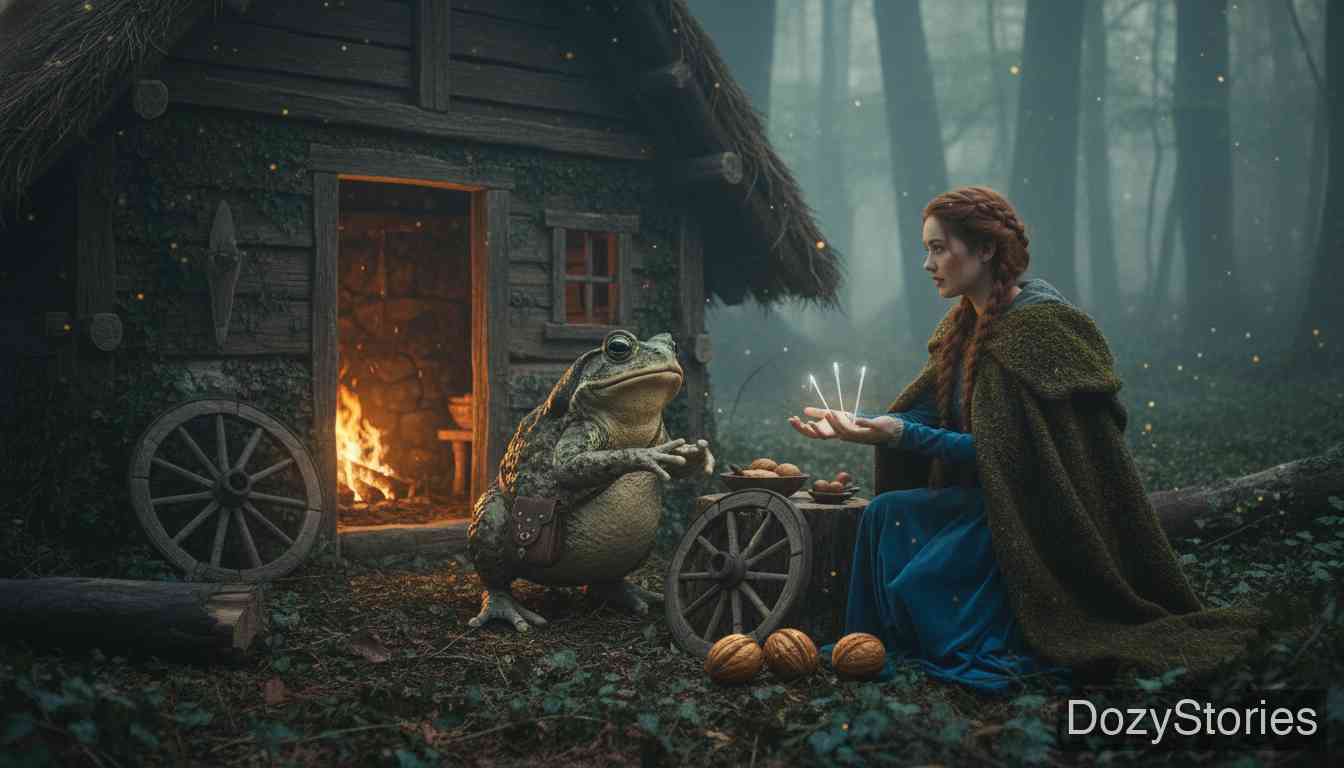
The Iron Stove - Lost and starving, the princess finds a hut of friendly toads; they feed and shelter her and give her three needles, a plough-wheel, and three nuts to pass the trials ahead. - Scene Illustration 3
Lost and starving, the princess finds a hut of friendly toads; they feed and shelter her and give her three needles, a plough-wheel, and three nuts to pass the trials ahead.
When evening came, the princess climbed a small tree to sleep, for she feared wild beasts. Near midnight she saw a faint light far away. "Perhaps there I will be safe," she thought. Down she climbed and walked toward the light, praying as she went.
She reached a tiny old house, buried in grass, with a small pile of wood by the door. She peeped through the window. Inside she saw only toads, big and small — and a table full of wine and roast meat, with silver plates and cups. She took heart and knocked. A fat toad sang out:
"Little green serving maid, Little maid with a limp, Little dog with a limp, Hop here and hop there, And see who knocks at the door."
A small toad opened the door, and all the toads made the princess welcome. They asked where she came from and where she was going. She told them everything: how she had broken the rule of three words, how the stove and the prince had vanished, and how she meant to search over hill and valley until she found him. Then the fat old toad sang again:
"Little green serving maid, Little maid with a limp, Little dog with a limp, Hop here and hop there, And bring me the great box."
The small toad brought the box. Then they gave the princess food and drink and led her to a soft bed, fine as silk and velvet. She slept until morning. At sunrise the old toad took out three needles, a plough-wheel, and three nuts. "You will need these," she said. "A high glass mountain, three sharp swords, and a great lake lie ahead. Cross them all, and you will hold your love again. Guard these gifts with care."
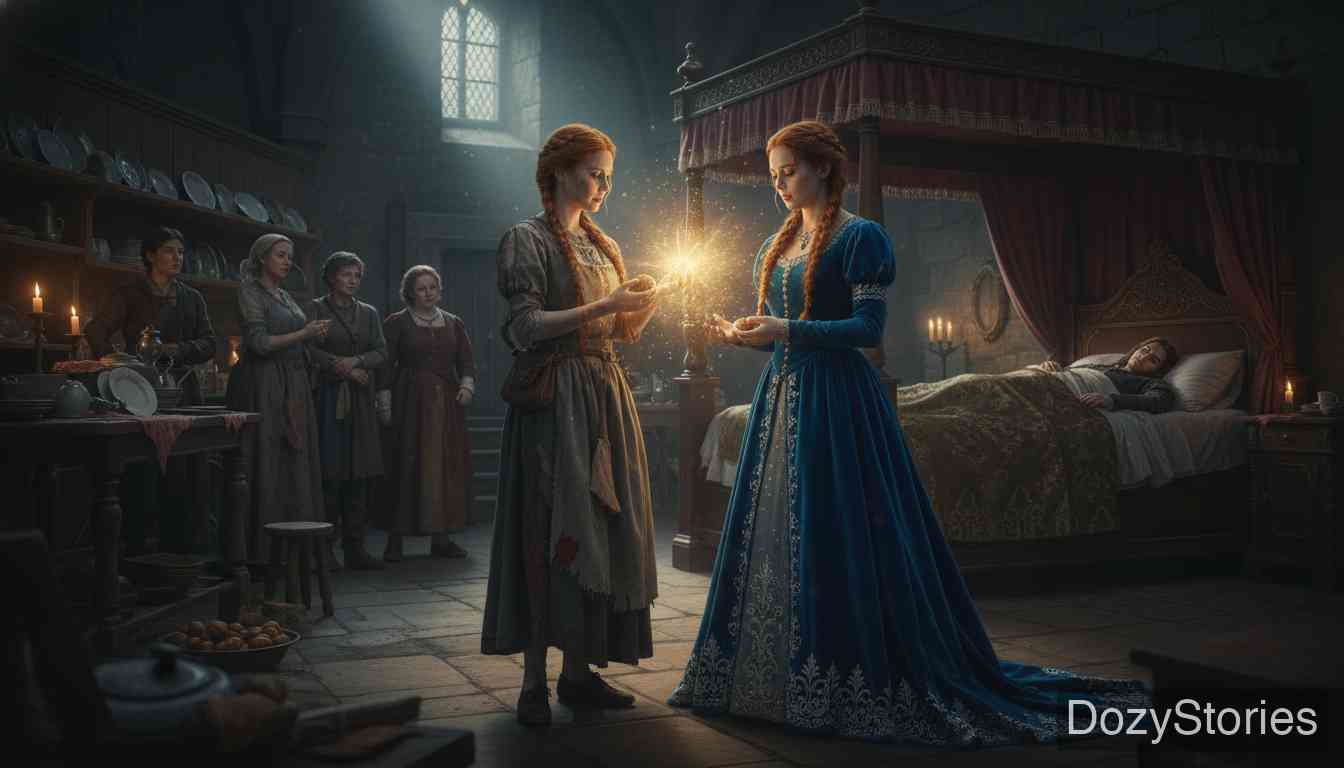
The Iron Stove - With her treasures the princess crosses the glass mountain, the swords, and the lake, then works as a scullery maid. She trades dresses from the nuts for two nights at the bridegroom's side, but he is drugged and cannot hear her. - Scene Illustration 4
With her treasures the princess crosses the glass mountain, the swords, and the lake, then works as a scullery maid. She trades dresses from the nuts for two nights at the bridegroom's side, but he is drugged and cannot hear her.
The princess set out with her gifts. The glass mountain was so slippery that she had to stick the three needles into it, step by step, to climb over. She hid the needles where she would remember. Next came three sharp swords, so she sat on her plough-wheel and rolled across them. Then she crossed the great lake and came to a large, beautiful castle.
She asked for work, saying she was a poor girl. But she knew well that the prince she had freed lived in this castle. They hired her as a scullery maid for little pay. The prince, however, had a new bride waiting for him — he thought the princess who saved him was long dead.
That evening, after washing the dishes, she felt the three nuts in her pocket. She cracked one open to eat the kernel — and inside lay a fine royal gown. When the bride heard of the gown, she came at once to buy it. The princess would not sell it. "You may have it," she said, "if you let me sleep one night in the bridegroom's room." The bride wanted the gown so much that she agreed.
That night the bride said to the prince, "That silly girl will sleep in your room." — "If you wish it, so be it," he said. But she gave him a glass of wine with a sleeping drug in it. He slept so deeply that the princess could not wake him.
All night she wept. "I set you free from the iron stove," she cried. "I crossed the glass mountain, the three swords, and the great lake to find you — and still you cannot hear me!" The servants listened outside the door all night, and in the morning they told their master.
The next evening, she opened the second nut and found a dress even more beautiful. Again the bride wanted to buy it, and again the princess asked only for one more night in the bridegroom's room. Once more the bride gave him a sleeping drug, and he heard nothing. The princess wept all night, and the servants listened and reported it once more.
The Iron Stove - On the third night the prince secretly pours away the drug and knows his true rescuer. They flee to the forest hut, where the toads are royal children again and the hut is a great castle — and they live happily ever after. - Scene Illustration 5
On the third night the prince secretly pours away the drug and knows his true rescuer. They flee to the forest hut, where the toads are royal children again and the hut is a great castle — and they live happily ever after.
On the third evening, she opened the last nut, and inside lay a dress stiff with pure gold, lovelier than all the rest. The bride wanted it at once. "Take it," said the princess, "but let me sleep one more night in his room."
This time the prince was watchful, and he poured the sleeping drug away. So when the princess wept and cried, "Dearest, I set you free from the iron stove in that wild forest," he leapt up. "You are the true one!" he said. "You are mine, and I am yours."
That very night they rode away in a carriage, and they took the false bride's clothes so she could not follow. They crossed the lake by boat, rolled over the three swords on the plough-wheel, and climbed the glass mountain with the needles. At last they reached the little old house.
But when they opened the door, they found a great castle! The toads were free from the spell at last, and they were truly a king's sons and daughters, full of joy.
There the wedding was held, and the two of them lived in that castle, which was grander than the castles of their fathers. The old king, lonely at home, was brought to live with them, so the two kingdoms were joined. The prince and the princess lived happily all their days. Remember: keep your word, and never give up, for a true heart finds its way home. A mouse did run — and the story is done.

Vocabulary from "The Iron Stove"

12 key words from this story with definitions and original context sentences for language learners.

scrapeB2
/skreɪp/v.

To rub something hard with a sharp edge to remove bits of it.

用利器刮;刮擦。

"Then come back here," said the prince, "and bring a knife to scrape a hole in the iron."

“你回去后带一把刀来,在铁皮上刮出一个洞。”

vanished(vanish)B2
/ˈvænɪʃt/v.

Disappeared suddenly, as if by magic.

突然消失;不见了。

She told them everything: how she had broken the rule of three words, how the stove and the prince had vanished, and how she meant to search over hill and valley until she found him.

她违了“只说三个字”的规矩,铁炉子和王子转眼不见了;她发誓翻山越岭,也要把他找回来。

peeped(peep)B2
/piːpt/v.

Looked quickly through a small opening.

从小孔或缝隙里张望;偷看。

She peeped inside and saw a handsome youth, bright with gold and jewels.

她探头一望,里面是一位俊美的少年,浑身金饰宝石,闪闪发光。

slipperyB1
/ˈslɪpəri/adj.

So smooth that it is hard to stand or walk on.

滑的;容易打滑的。

The glass mountain was so slippery that she had to stick the three needles into it, step by step, to climb over.

玻璃山滑得像镜子,她把三根针一根根扎进山里,扎一步,爬一步,终于翻了过去。

plough-wheelB2
/ˈplaʊ wiːl/n.

A wheel on a plough, a farm tool for turning over soil.

犁轮(犁上装的轮子,犁是翻土的农具)。

Next came three sharp swords, so she sat on her plough-wheel and rolled across them.

三把利剑挡路,她便坐上犁轮,从剑刃上滚了过去。

sculleryC1
/ˈskʌləri/n.

A small room next to the kitchen where dishes are washed.

洗碗间;厨房里洗刷碗碟的小房间。

They hired her as a scullery maid for little pay.

管家收她做了洗碗女佣,工钱微薄。

kernelC1
/ˈkɜːnl/n.

The soft part inside a nut that you can eat.

果仁;坚果里面可食用的部分。

She cracked one open to eat the kernel — and inside lay a fine royal gown.

她咬开一颗,正要吃果仁——里面竟躺着一件华贵的礼服。

gownC1
/ɡaʊn/n.

A long, beautiful dress, often worn by royalty.

长礼服;华美的长裙。

When the bride heard of the gown, she came at once to buy it.

新娘听说了这件礼服,赶来要买。

wept(weep)B2
/wept/v.

Cried with tears.

哭泣;流泪。

The princess wept when she heard this, but a promise is a promise.

公主听了这话,泪流满面,可事到如今,只能守信。

stiffB2
/stɪf/adj.

Firm and hard, not easy to bend.

硬挺的;不易弯曲的。

On the third evening, she opened the last nut, and inside lay a dress stiff with pure gold, lovelier than all the rest.

第三天傍晚,公主咬开第三颗坚果,里面是一件纯金做的礼服,硬挺挺、亮闪闪,比前两件更动人。

watchfulB2
/ˈwɒtʃfl/adj.

Careful and alert, watching for danger or tricks.

警觉的;留神的。

This time the prince was watchful, and he poured the sleeping drug away.

这一回,王子多了个心眼,悄悄把安眠药倒掉了。

ruins(ruin)B2
/ˈruːɪnz/n.

The broken parts of a fallen building or kingdom.

废墟;倒塌破败的景象。

If she does not come, the whole kingdom will fall in ruins, and no stone will stay upon another.

她若不来,整个王国就要化为废墟,一块石头也不许留在另一块上面。

Reading Together & Learning More

The Moral

A promise weighs more than gold, and a moment of carelessness must be repaid with patient courage. Those whose hearts stay true will win back the happiness they lost.

Educational Value

Shows children the virtues of keeping one's word and never giving up: a trial we overcome ourselves is worth more than a rescue we wait for. It also teaches that one mistake is not the end — as long as we keep trying, we can still make things right.

Tips for Parents

After reading, ask your child why a few extra words cost the princess her prince, and why she still dared a third night after failing twice. Introduce phrases like 'keep one's word' and 'never give up', and look together for the moments where the princess shows them.

Talk About It

  1. The princess loses the prince just by saying a few extra words. Is that rule fair? Could you have stopped at three words?
  2. The miller's daughter and the swineherd's daughter scrape the stove in vain, but the princess succeeds. Why do you think that is?
  3. The toads give her three needles, a plough-wheel, and three nuts. Which really carries her through — the magic gifts, or her own will?
  4. For two nights the prince cannot hear her. After failing twice, why does she try a third time? Would you?
  5. When he is drugged, the prince cannot hear her, but on the third night he knows her at once. What makes him recognize her?